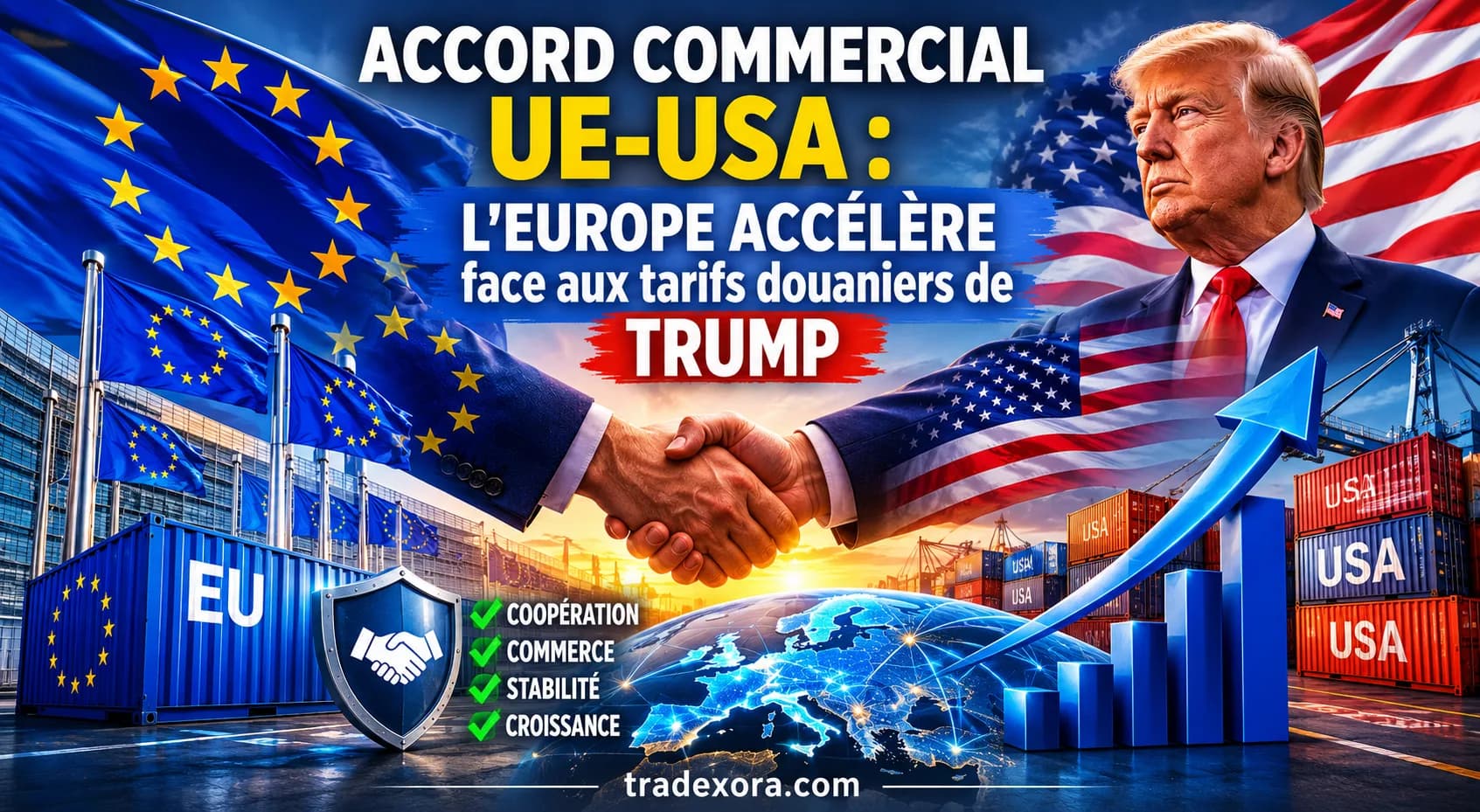
EU-US Trade Deal: Europe Accelerates Amidst Trump's Tariffs
The European Union has finalized the text of a trade agreement with the United States, accelerating its ratification to avoid new customs duties. This swift decision comes after months of tense negotiations and could have significant repercussions on global markets.
In a strategic move aimed at de-escalating a potential tariff escalation, the European Union has concluded the text of its trade agreement with the United States. This finalization, which comes earlier than expected, is a direct response to President Donald Trump's threats to impose additional customs duties on European imports. The speed with which the EU has wrapped up these negotiations, after months of sometimes arduous discussions, reflects the pressure exerted by the American administration and the European desire to avoid a costly trade war.
An Agreement Under Pressure: The Resolution of Transatlantic Negotiations
The agreement, whose precise details are yet to be fully disclosed, aims to facilitate trade between the two major economic blocs. It potentially covers various sectors, ranging from automobiles to agricultural products, as well as services. The conclusion of this text constitutes a crucial step, removing a major obstacle to the formal ratification of the pact. The preceding months have been marked by intense negotiations, where each party sought to defend its interests while navigating a complex geopolitical context. The imminent threat of higher customs duties clearly served as a catalyst, pushing both sides to find common ground.
According to reports from Bloomberg, the EU's haste to finalize this agreement is part of a proactive approach to anticipate the deadlines set by the American administration. The objective is to present a text ready for ratification, thereby demonstrating the EU's good faith and willingness to cooperate. This approach aims to send a strong signal to Washington, hoping to deter the imposition of new trade barriers that could harm the global economy. The details concerning mutual concessions and the areas where compromises have been made will be decisive in assessing the true scope of this agreement.
Why This Agreement is Crucial for Market Stability
The conclusion of a trade agreement between the EU and the United States is an event of paramount importance for global financial markets. The uncertainty surrounding transatlantic trade relations has weighed on investor confidence and the predictability of trade flows in recent months. The imposition of new customs duties could have triggered retaliatory measures, leading to a protectionist spiral with potentially devastating consequences for global economic growth. The agreement, by dispelling this immediate threat, brings a welcome dose of stability.
Market dynamics are often influenced by announcements related to trade policies. An escalation of tensions, such as the one feared with the implementation of new tariffs, could have led to increased volatility in stock markets, a strengthening of the dollar against the euro, and a downward revision of growth prospects for many companies exposed to international trade. Conversely, the conclusion of an agreement, even if not perfect, helps to restore a degree of predictability. This is particularly relevant for European companies that export heavily to the United States, as well as for American multinationals with significant operations in Europe.
Financial analysts, including those from The Wall Street Journal and the Financial Times, have highlighted that resolving this trade tension could encourage business investment. Increased visibility on costs and export opportunities allows business leaders to make more informed investment decisions. Furthermore, reduced geopolitical uncertainty can free up capital that would otherwise be held back, thus boosting liquidity and potentially the performance of financial assets.
Impact for the French Investor: PEA, ETFs, and Stocks Under the Microscope
For the French investor, whether operating through a Plan d'Épargne en Actions (PEA), a standard securities account (CTO), or life insurance, this trade agreement has several concrete implications. Firstly, the stabilization of Euro-American trade relations is good news for European companies, and particularly French ones, which are highly integrated into global value chains and export a significant portion of their production to the United States. Sectors such as luxury goods, automotive, aeronautics, and agri-food could benefit from increased visibility and reduced pressure on their margins.
Concretely, this could translate into better performance for shares of companies like LVMH, Hermès, Kering in luxury, Stellantis or Renault in automotive, and Airbus in aeronautics. These companies, a significant portion of whose revenue comes from the United States, could see their stock prices react positively to the dissipation of tariff risk. For investors holding these shares directly in their PEA or CTO, close monitoring of their quarterly reports will be necessary to assess the direct impact of this agreement on their results.
Regarding ETFs, those that replicate broad indices like the MSCI World ETF or European indices like the CAC 40 or the Euro Stoxx 50, should indirectly benefit from this easing of tensions. Lower volatility and increased market confidence tend to support the overall performance of these indices. Investors favoring sector-specific ETFs may also find opportunities. For example, an ETF focused on European industrial stocks could capture part of the expected recovery in this sector. It is essential to check the composition of these ETFs to ensure they have relevant exposure to companies likely to benefit from this agreement.
French taxation, particularly that applied to capital gains on shares held in a PEA, makes this agreement particularly relevant for investors seeking to optimize their net return. Improved stock market performance thanks to this agreement will translate into capital gains which, after 5 years of holding a PEA, are exempt from income tax (excluding social security contributions). For investors using a CTO, the capital gain will be subject to the Flat Tax (PFU) of 30% or the progressive income tax scale, depending on their choice. The impact on life insurance will depend on the type of contract (in units of account or in euro funds) and the underlying assets.
Outlook: A Respite or a New Chapter in Global Trade?
The conclusion of this trade agreement represents a significant respite from a potential protectionist escalation. It helps to restore a certain balance in transatlantic economic relations and offers a breath of fresh air to businesses and markets. However, it is crucial not to consider this agreement as an end in itself. The geopolitical context remains volatile, and new trade tensions could emerge in the future, whether with the United States or other trading partners. The exact nature of the concessions made by each party will also determine the long-term sustainability and effectiveness of this arrangement.
The coming months will be decisive in observing the concrete implementation of this agreement and its real impact on trade and economic growth. Investors will need to remain vigilant regarding future developments in trade policies and the reactions of various economic actors. The ability of the EU and the United States to maintain constructive dialogue will be essential to navigate an ever-changing global economic landscape. The outcome of this negotiation could serve as a precedent for other future trade agreements, influencing the trajectory of global trade for years to come.
Legal Disclaimer: This article is for informational purposes only and does not constitute investment advice. The information provided is based on public data and market analysis. Past performance is not indicative of future results. All investments involve the risk of capital loss. It is recommended to consult a professional financial advisor before making any investment decisions.