Binance breach triggers $1.5B in liquidations, 84% long positions
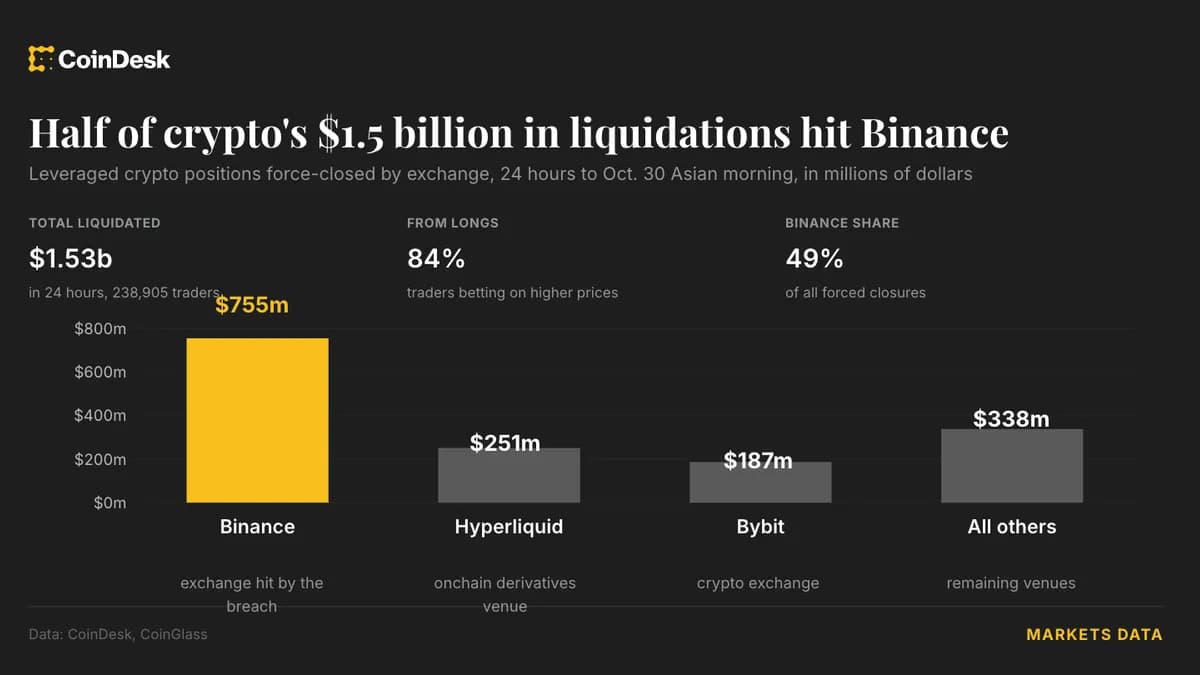
A security breach at Binance triggered $1.53B in forced liquidations, 84% of which were long positions, affecting Bitcoin, Ether, and other major tokens. Binance absorbed nearly half the total, while price rebounds have already begun hitting short sellers.
A wave of $1.53B in forced liquidations shook the cryptocurrency market following Binance's security breach. According to CoinDesk, long positions accounted for 83.8% of total closures, or approximately $1.29B. The initial drop saw Bitcoin hit $76,460 before rebounding toward $78,500. Traders lost nearly $499B in Bitcoin liquidations alone, illustrating the risks of margin trading. This dynamic triggered a chain reaction across other major assets.
Total liquidations reach $1.53B, 84% in long positions
CoinGlass indicates that total liquidations amounted to $1.53B over 24 hours, of which 83.8% (approximately $1.29B) came from long positions. The peak occurred over the last 12 hours, which concentrated $1.37B in liquidations, including $1.23B in long positions. This concentration shows how a sharp drop can quickly exhaust traders' margins. The remaining liquidations mainly concerned short positions, which were less exposed in this move.
CoinDesk data specifies that short positions were liquidated to the tune of $57.3B out of the $85B liquidated over the last four hours, or 67% of that slice's volume. This significant share reflects the chain reaction of forced sales that fueled the initial downward pressure. Nevertheless, shorts represent a distinctly smaller proportion of the daily total, confirming the dominance of bullish bets in this episode.
Binance responsible for nearly half of forced closures
Binance recorded $754.6B in liquidations, representing 49.2% of the global total according to CoinGlass. Of this amount, $670.6B concerned long positions, underscoring the platform's central role in triggering the sell-off. The concentration of closures on Binance is explained by the scale of assets frozen during the security breach. The platform suspended deposits and withdrawals while conducting security checks, as stated in the announcement.
Other exchanges also participated in the process: Hyperliquid generated $251.4B in liquidations, while Bybit recorded $186.5B. Even though these figures remain significantly lower than Binance's, they show that the turbulence spread across multiple platforms. All of these closures contributed to the global market collapse in under 24 hours.
Bitcoin and Ether drive more than half of liquidations
Bitcoin liquidations totaled $499B, and Ether's $358B, together accounting for more than half of the $1.53B total. As market benchmarks, these two assets drove the majority of leveraged traders' losses. Bitcoin's price fell to $76,460 before recovering, while Ether hovered around $2,240 after briefly breaking below the $2,200 mark. Their volatility amplified margin calls on long positions.
Other tokens also suffered significant liquidations: Solana generated $82.6B, XRP $38.1B, and Dogecoin $18.6B. While these amounts are more modest, they contribute to the overall impact on the crypto market. The breakdown shows that major assets remain the most exposed to mass movements.
Bitcoin rebound pushes short sellers into liquidation
When Bitcoin rebounded toward $78,500, short traders were forced to buy back their positions, generating $57.3B in liquidations over the last four hours. Over the last hour, short positions accounted for 95% ($20.6B out of $21.6B) of liquidations, underscoring the intensity of the reversal. This forced-buying dynamic added further upward pressure on Bitcoin's price.
The phenomenon illustrates the short liquidation mechanism: rising prices force sellers to buy back, which further fuels the rise. Thus, Bitcoin's rebound simultaneously limited longs' losses and exacerbated shorts', creating a seesaw effect on the order book. CoinDesk data confirms this reversal began in the early hours of the Asian morning.
Breakdown of losses across major assets and exchanges
The largest liquidated trade was an $11B Bitcoin long on Binance, according to CoinGlass. This exceptional liquidation shows the massive exposure of certain players to the bull market. Cumulatively, losses on Bitcoin and Ether exceed $850B, while other tokens represent the remaining balance.
Binance announced it would cover losses and froze deposits and withdrawals to secure the $6.3B in affected assets. This measure aims to restore user confidence after the breach. Other platforms, though less impacted, have also tightened controls to prevent further disruptions.
After the initial drop, Bitcoin found a floor around $78,500, allowing short sellers to close their positions at a loss but stabilizing the price. The rebound limited the chain reaction of new massive liquidations, offering a breather to long traders. Trading volumes remained high, however, reflecting persistent intense speculative activity.
The crypto market remains under pressure, but Bitcoin's recovery shows prices can quickly rebound after a sharp correction. Market participants will need to closely monitor upcoming margin movements, particularly on platforms that have already suffered significant losses. According to CoinDesk, the situation remains volatile, but the current scenario points to possible medium-term stabilization.