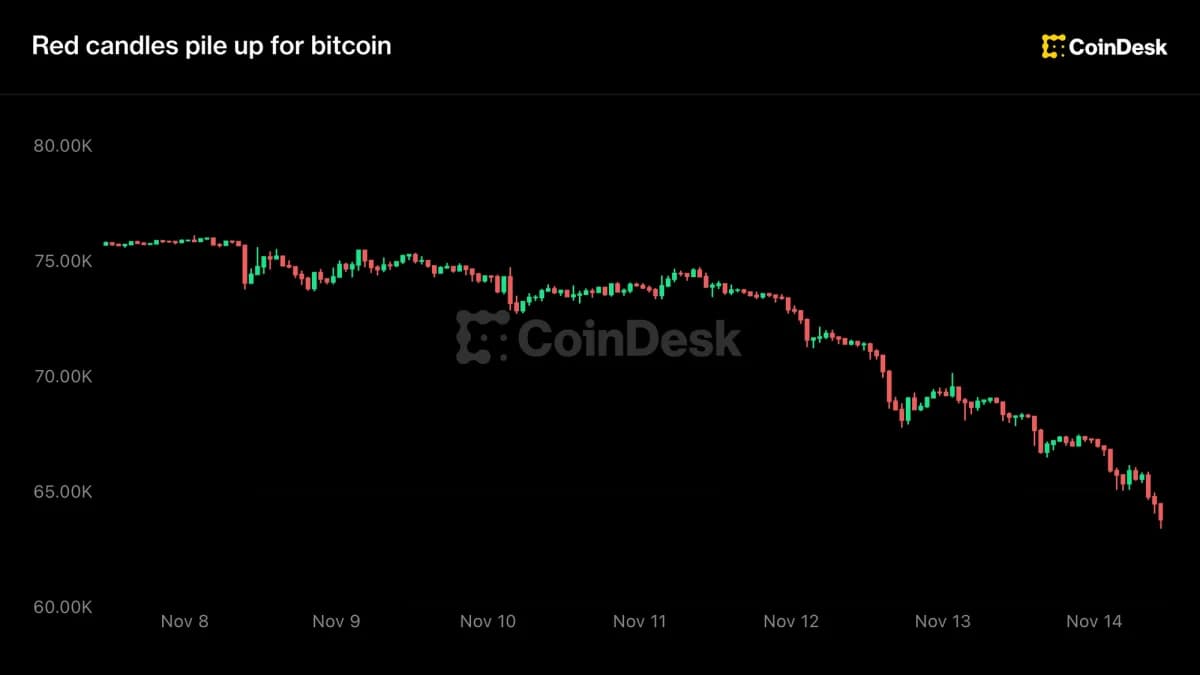
The price of Bitcoin has fallen by 8% since the close of US stock markets on Friday evening, reaching a three-month low. Analyst James Check suggests this drop could signal a fourth wave of capitulation.
Abrupt Bitcoin Slide in Context of Multiple Capitulations
The price of Bitcoin has experienced an abrupt 8% drop since the close of the US stock market on Friday evening, settling at $62,500, its lowest level since March 2023. This drop places the leading digital asset at a new three-month low, slightly above the $62,000 threshold, a level not seen since the first quarter of the year. The movement is part of a broader dynamic where Bitcoin has lost 17% of its value over the past week, reflecting generalized selling pressure across the cryptocurrency market.
Fourth Wave of Capitulation According to James Check
Analyst James Check, who has been tracking market cycles for several years, has identified this drop as the "fourth capitulation event" since the historic peak reached at the end of the previous year. In his analysis, he notes that most current sellers are actors who, three months ago, bought Bitcoin at over $80,000 – a price that was then perceived as a summit but has since proven to be an excessive entry point. These investors, often referred to as "FOMOers" (Fear Of Missing Out), have seen their positions quickly turn into losses as the price began a severe correction.
Check adds that many market participants were hesitant six months ago when the price range was between $60,000 and $70,000, preferring to stay out of the market. This hesitation, combined with a sudden rebound above $80,000 in September, created a situation where actors who eventually succumbed to FOMO were forced to sell at levels they would have liked to reach three months earlier. This dynamic of selling at a loss constitutes, according to him, the very heart of capitulation: actors who had hoped to profit from a rally find themselves forced to liquidate their positions, exacerbating downward pressure.
"Deep Value Zone" Concept and Its History
James Check describes the current level of $62,500 as a "deep value zone." This zone has been observed at two specific moments in 2026: in February and at the end of June. Before these episodes, a similar situation occurred during the crypto winter of 2022, when Bitcoin also found a floor before gradually rebounding. The term "deep value zone" refers to a price level where the asset is perceived as undervalued relative to its technical fundamentals (for example, moving averages, historical support levels) and where long-term buyers begin to reappear.
However, it is important to note that entering a deep value zone does not guarantee the immediate attainment of a definitive floor. History shows that the first actors who "leg-in" (i.e., who begin to gradually accumulate) in these zones often end up realizing profits when the price rebounds, but the timing of this turnaround remains uncertain and depends on macroeconomic factors and market sentiment.
Correlation with Stock Markets and Risk-Off Factor
The drop in Bitcoin occurred in parallel with a correction in US stock markets. The S&P 500 recorded a drop of over one percent on the preceding Thursday, while the Nasdaq, an index heavily weighted in tech stocks, lost more than two percent. This co-decline underscores the growing interconnectedness between digital assets and traditional markets, particularly in periods of macroeconomic tension where investors adopt a "risk-off" posture. In such an environment, capital leaves perceived riskier assets – like cryptocurrencies – in favor of safer instruments or liquidities.
The phenomenon of capitulation observed on Bitcoin reflects a collective reaction to both losses incurred on stocks and uncertainties related to new financial technologies, as shown by the impact of Anthropic's IPO. Investors, fearing that capital inflows into tech IPOs may divert funding from digital assets, have intensified selling pressure.
Impact on Other Major Cryptocurrencies
Bitcoin is not the only one experiencing sell-offs. Ether (ETH), the second-largest cryptocurrency by market cap, has fallen by 22% since the start of the week, while XRP and Solana (SOL) tokens have recorded similar losses, oscillating between 20% and 25%. This downward correlation among major digital currencies indicates a generalized panic, where investors liquidate their positions simultaneously, amplifying market volatility.
These movements are also consistent with the capitulation model described by Check: when an asset class experiences significant selling pressure, correlated assets often follow suit as institutional portfolios and investment funds rebalance their allocations to reduce overall risk exposure.
Economic Mechanisms Underlying Capitulation
Capitulation is an economic term that refers to the moment when investors, after a prolonged period of losses, decide to sell their assets, even at prices significantly below their initial purchase levels. This behavior is often triggered by two main factors: loss aversion and liquidity pressure. When prices drop rapidly, market participants may be forced to sell to cover other positions or meet margin requirements, creating a vicious cycle of selling that exacerbates the price decline.
In the case of Bitcoin, the combination of an 8% drop in a single session and a weekly loss of 17% has intensified loss sentiment among recent holders, particularly those who bought at the peak of $80,000. The rapid loss of value has triggered margin calls for leveraged traders, forcing position liquidation and further fueling the bearish dynamic.
Technical Analysis and Key Levels to Watch
From a technical perspective, the $62,500 level represents an important support zone, located near the 50-day simple moving average that has long served as a reference for Bitcoin traders. A break below this support could open the door to lower price levels, potentially around $58,000 to $60,000, which correspond to the lows observed in February and June. Conversely, if the price manages to stabilize above $62,500, it could indicate a gradual absorption of selling pressure and set the stage for a technical rebound, possibly towards resistance levels around $66,000 to $68,000, which previously served as ceilings before major corrections.
Volume indicators also show a notable increase in trading activity during the drop, confirming the engagement of institutional actors and large portfolios in liquidation. This increase in volume, coupled with the formation of consecutive red candlesticks, is a signal of strengthening short-term bearish momentum.
Medium-Term Outlook and Potential Reversal Factors
Although the article should not contain a "Conclusion" section, it is essential to outline the variables that could influence a potential price stabilization. The primary catalyst would be a recovery in market sentiment, often triggered by positive news such as favorable regulatory announcements, institutional adoption, or technological developments (example: Bitcoin protocol improvements, adoption of layer 2 solutions).
Moreover, macroeconomic dynamics, notably decisions on monetary policy by the Federal Reserve, play a crucial role. An accommodative monetary policy (low interest rates) tends to support risk assets, while a restrictive policy (high interest rates) accentuates capital movement towards safer assets. In the current context where stock markets are correcting, any sign of stabilization or rebound in stock indices could alleviate selling pressure on Bitcoin.
Finally, the Anthropic IPO remains a point of attention. If the IPO goes smoothly and investors perceive cryptocurrencies as complementary rather than competing, the "jitters" effect could abate, reducing the additional risk factor weighing on the crypto market.
In summary, the drop in Bitcoin to $62,500 reflects a confluence of factors: a fourth wave of capitulation, negative correlation with stock markets, increased liquidity pressure, and loss sentiment among recent investors. The deep value zone identified by James Check offers a framework for actors considering re-accumulation, but the timing of any turnaround will depend heavily on market sentiment evolution and underlying macroeconomic variables.