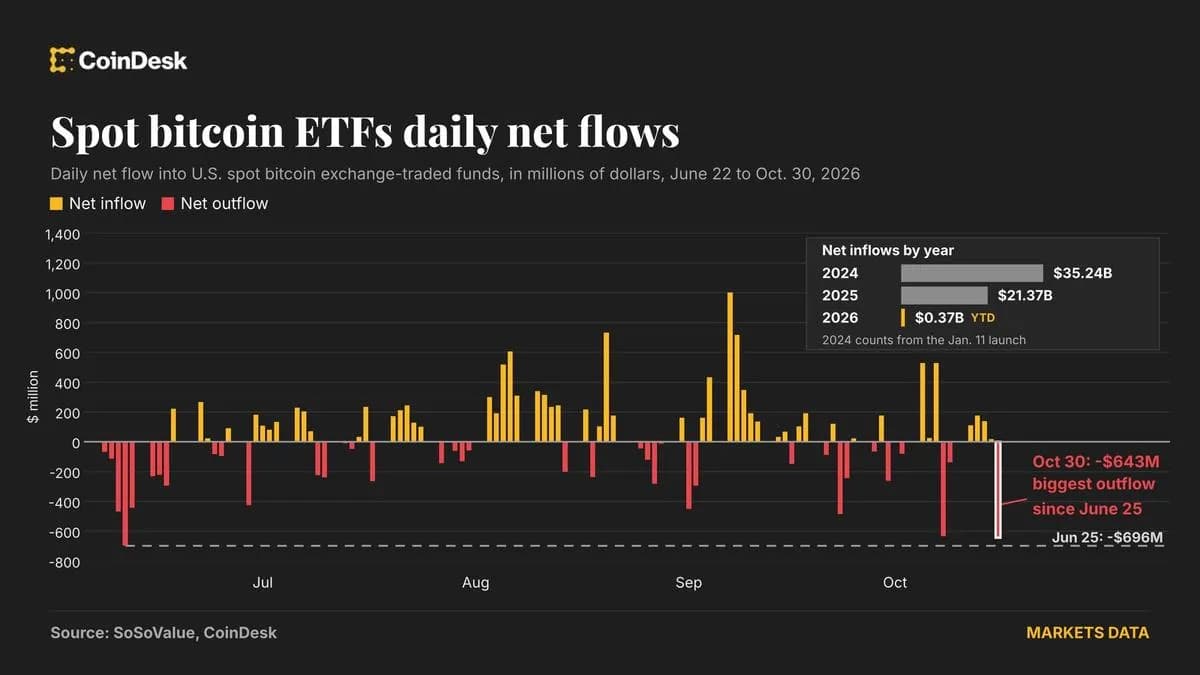
Bitcoin ETFs Record $643 M Outflows, the Largest Since June 25
U.S. listed Bitcoin-backed funds saw $643.3 M exit in a single day, representing 63.6 % of their net inflows for the year. The Binance hack and a negative Coinbase premium fueled this capital outflow, bringing total assets under the $100 M threshold.
U.S. listed funds that hold Bitcoin recorded a net withdrawal of $643.3 M on Friday, October 30, the biggest daily exodus since June 25, when $696.3 M fled. This outflow represents 63.6 % of the year‑to‑date net flow, which had stood at just over a billion dollars before the drop. The phenomenon comes immediately after the hack of the Binance platform, which sowed uncertainty among institutional investors.
Outflows of $643 M: the Largest Withdrawal Since June 25
According to SoSoValue data relayed by CoinDesk, U.S.-listed spot Bitcoin ETFs lost $643.3 M in a single session, marking the 12th largest withdrawal since the products launched in January 2024. Prior to this episode, the funds showed an annual net inflow of slightly more than a billion dollars, a gain now reduced to $362.7 M after Friday’s outflow.
The withdrawal also pushed the total assets of Bitcoin ETFs below the symbolic $100 M barrier, reaching $98.14 M according to Bitfire Research. This sizable decline comes as the market closely watches the U.S. mid‑term elections on November 3, the employment report on November 6, and the possible exclusion of large Bitcoin holders from MSCI indices.
BlackRock IBIT and Fidelity FBTC Lead the Outflows
BlackRock’s IBIT fund led the disengagement wave with a loss of $233.70 M, closely followed by Fidelity’s FBTC product, which saw $201.4 M exit. These two vehicles represent the biggest players in the segment, underscoring institutional investors’ sensitivity to recent shocks.
The massive outflows from these two funds accounted for roughly $435 M combined, or nearly two‑thirds of the daily total. The remainder of the outflows came from a multitude of smaller funds that, collectively, added $208 M to the withdrawals.
The Binance Hack Triggers the Capital Flight
Derive, a decentralized exchange platform, attributed the capital flight to the Binance hack, estimated at $6.3 M and occurring on Thursday night. “The market was already under pressure, but the Binance hack added an extra layer of uncertainty,” said a Derive spokesperson, cited by CoinDesk.
This shock pushed investors to quickly reduce their positions in Bitcoin‑linked products, preferring the liquidity and perceived safety of other asset classes while awaiting clarification of the situation.
Negative Coinbase Premium and Falling Fear & Greed Index
The Coinbase premium, a metric followed to gauge U.S. investors’ buying pressure, settled between –0.18 % and –0.27 %, confirming a waning demand dynamic. At the same time, the Crypto Fear & Greed Index slipped into the 30‑34 range, reflecting a moderate fear atmosphere among market participants.
These two indicators, together with the ETF outflows, illustrate a notable loss of confidence, especially among institutional players who use ETFs as a proxy for real Bitcoin demand.
Impact on Bitcoin‑Linked Assets and Short‑Term Outlook
The $643 M withdrawal pulled the total assets of Bitcoin ETFs down to $98.14 M, a level not seen since the first product launched in 2024. This contraction could reduce the liquidity available for spot transactions, amplifying Bitcoin’s price volatility, which was trading around $76,611 at the time of the outflow.
Bitfire analysts note that the combination of the hack, the negative premium, and U.S. political uncertainties creates a “short‑term scenario where outflows could persist.” They nevertheless recommend monitoring upcoming macro reports, especially the November 6 employment report, which could revive markets if the data turn out better than expected.
Reaction of Traditional Markets and Implications for Investors
Bitcoin ETF outflows have had a ripple effect on related digital assets, with Ethereum ETFs also showing sustained weekly withdrawals. In traditional markets, U.S. equity indices closed slightly lower, reflecting overall nervousness tied to geopolitical and technological risks.
For French investors exposed to crypto‑assets via PEA or securities accounts, the drop in Bitcoin ETF assets underscores the importance of diversification and vigilance in the face of security events. A deeper look at ETF flow trends is available on the page ETF MSCI World CW8, which offers a broader perspective on capital movements in alternative assets.