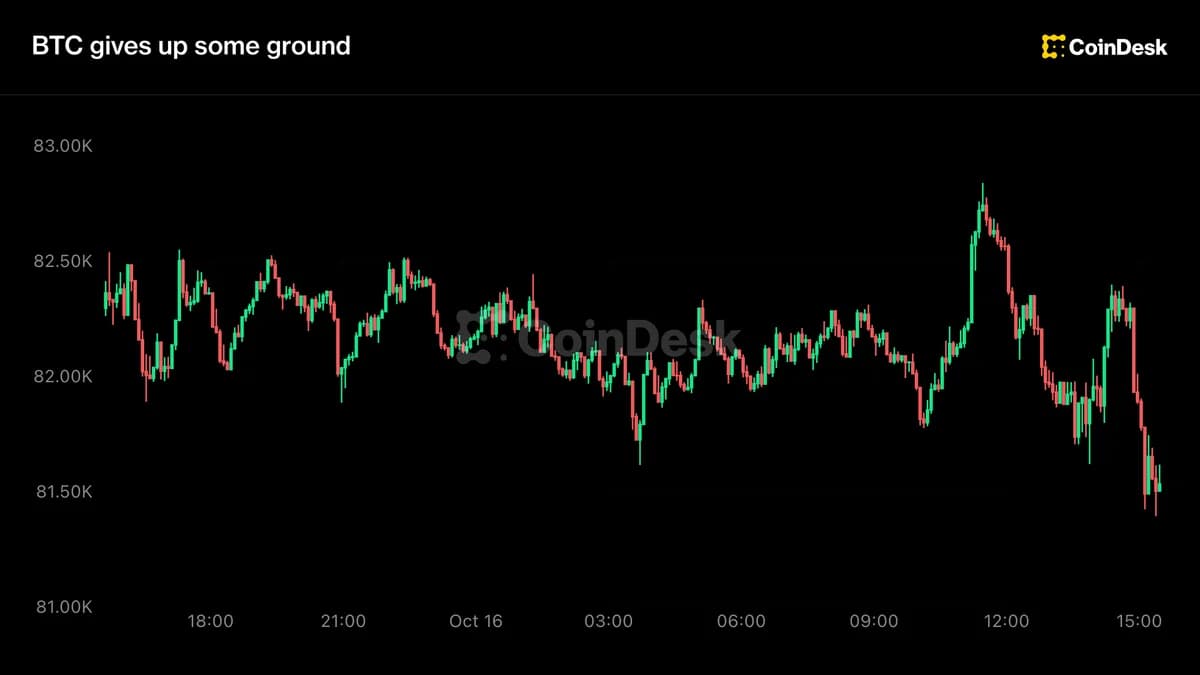
Bitcoin drops to $81,500 as Nasdaq falls 2% and VIX rises 22%
Bitcoin has lost 1% over the past 24 hours, dropping to $81,500, while the Nasdaq fell 2.15% and the VIX surged 22% as markets approach the 39th anniversary of Black Monday. US stock markets are showing volatility, fueling investor nervousness.
Bitcoin is trading at $81,500, down 1% over the past 24 hours, while the Nasdaq dropped 2.15% and the VIX volatility index spiked 22% (CoinDesk). This convergence of movements coincides with the 39th anniversary of "Black Monday," the Friday before the 1987 stock market crash. US equity markets are showing significant nervousness, amplified by rumors of massive liquidations circulating without official confirmation. This fear is immediately reflected in the prices of high-risk assets, including the leading cryptocurrency.
Bitcoin at $81,500: 1% correction in 24 hours
After touching $82,000, Bitcoin has retreated approximately 1%, settling at $81,500 at the time of writing (CoinDesk). This correction comes as market participants scrutinize the signals of increased volatility on traditional markets. The 1% drop remains modest compared to Bitcoin's historical fluctuations, but it reflects growing tension in high-risk assets. Investors are now watching whether the price can hold this level or face further declines.
Bitcoin's movement is not isolated: it reflects the growing correlation between crypto assets and stock markets, particularly when the VIX indicates rising fear. According to analysts, Bitcoin volatility tends to increase when the VIX exceeds 20 points, which is currently the case. This dynamic could lead to additional capital flows out of cryptocurrencies, intensifying downward pressure.
Nasdaq down 2.15%: Tech sector under pressure
The Nasdaq, the benchmark for technology stocks, recorded a 2.15% decline during the same session (CoinDesk). This drop follows market momentum deceleration after a series of mixed corporate results and rising VIX levels, which have reached levels not seen in years. Large-cap stocks like Apple and Nvidia contributed to the decline, though their exact prices are not detailed in this report.
The Nasdaq's retreat fits into a broader context where investors are reassessing their positions amid macroeconomic uncertainty. Heightened volatility, measured by the VIX, acts as a catalyst pushing market players to reduce their exposure to tech stocks, traditionally seen as more sensitive to market sentiment fluctuations.
VIX soars 22%: Fear gauge reaches highs
The VIX index, often called the "fear gauge," jumped 22% in a matter of hours, reaching levels not seen since the post-pandemic crisis peak (CoinDesk). This spectacular rise reflects investor anxiety amid a Nasdaq decline and Bitcoin losing ground. The VIX serves as a reference for anticipating future stock market volatility, and its surge suggests that nervousness may persist.
When the VIX rises so sharply, hedging strategies multiply, driving up volumes in derivative instruments and putting downward pressure on risky assets. Portfolio managers often respond by increasing cash positions or safe-haven assets, further fueling the downward dynamic of asset prices.
Black Monday anniversary: Remembering the 1987 crash
This Monday marks the 39th anniversary of "Black Monday," the Friday before the 1987 stock market crash, when the S&P 500 plummeted over 20% in a single day (CoinDesk). While today's drop is not comparable – the Nasdaq only fell 2.15% – the historical reference acts as a psychological trigger for market players. The collective memory of the 1987 crash fuels caution, especially in a context where the VIX is surging.
The parallel with Black Monday reminds us that markets can turn rapidly when a combination of factors – volatility, economic uncertainty, and selling pressure – converge. Analysts emphasize that the lesson from 1987 remains relevant: risk management must be proactive, especially when fear indicators like the VIX cross critical thresholds.
Rumors of massive liquidations: Implications for crypto positions?
Rumors are circulating that certain players were forced to liquidate significant positions, but no official confirmation has yet emerged (CoinDesk). If these rumors prove true, they could explain the downward pressure on Bitcoin, which dropped 1% despite prior technical support. Mass outflows from crypto funds could increase volatility and push Bitcoin prices to new lows.
Until clarification arrives, investors remain cautious, favoring risk management strategies. The correlation between potential liquidations in traditional markets and Bitcoin's decline highlights the growing interdependence between asset classes, a phenomenon portfolio managers must integrate into their risk models.
Short-term scenarios for Bitcoin and stock markets
Short-term, Bitcoin could oscillate around $81,500 as long as the VIX maintains its elevated level and uncertainties around liquidations persist. A stabilization of the VIX could provide a floor for the cryptocurrency, while another rise in the VIX could push Bitcoin lower. On the Nasdaq side, a continuation of the 2.15% drop could trigger further retracement if Black Monday fears intensify.
Analysts recommend closely monitoring volatility indicators and capital flows between traditional assets and crypto assets. Any rebound in the Nasdaq or deflation in the VIX could support Bitcoin, while persistent high volatility could prolong the correction phase. The coming days will be decisive in determining whether the market enters a stabilization phase or sinks further into nervousness.