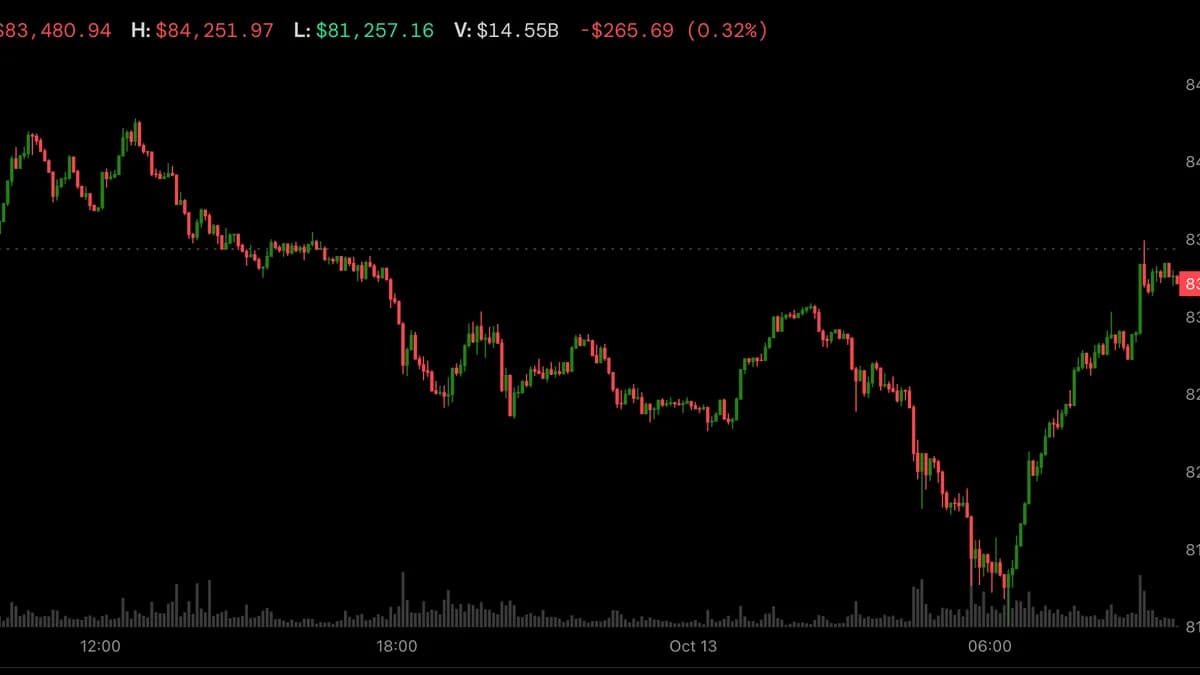
Bitcoin Bounces Back Above $83,000 as Korean Stocks Drop Over 6%
Bitcoin regains $83,000 after falling below $81,000, while the South Korean KOSPI drops over 6% and Nasdaq futures decline. The bounce occurs amid high oil prices and expectations around the upcoming U.S. CPI report.
Bitcoin surpassed $83,000 Tuesday, rebounding after a brief dip below $81,000 at 00h50 UTC. This recovery comes as Asian markets face strong corrections, with the South Korean KOSPI plunging over 6% and breaking below 6,000 points for the first time since July. Nasdaq futures fell 0.6%, intensifying risk-off pressures. Crude oil WTI remains near $92.67, while Brent hovers around $106 per barrel, fueling concerns about persistent inflation. According to CoinDesk, traders are awaiting Thursday's U.S. Consumer Price Index (CPI) report, which could redefine crypto market dynamics.
Bitcoin Breaks Above $83,000 After Dipping Below $81,000
Bitcoin (BTC) reached $82,292.69 before rebounding above the $83,000心理关口, marking a 2% gain since its low of $81,000. This rally was swift, with Bitcoin losing nearly 2% in less than an hour before recovering. The move was confirmed by CoinDesk data, showing Bitcoin regained the $83,000 level in under 30 minutes. Analysts note this rebound demonstrates Bitcoin's resilience to short-term market shocks. renewed confidence emerged despite increased volatility in tech stocks.
Ethereum also saw a rebound, climbing to $2,510.04, recovering from five-day lows. Other digital assets like XRP reversed their downtrend after hitting three-week lows. Zcash, Solana, and several major tokens followed a similar pattern, indicating a rotation among crypto assets. CoinDesk notes these parallel gains reinforce the idea of sectoral support within the crypto market. Bitcoin remains above its key resistance zone, offering support for the coming days.
Korean Tech Stock Rout Triggers Crypto Pullback
The KOSPI fell over 6% intraday, dropping below 6,000 points, its lowest level since late July. Shares of South Korean semiconductor giants Samsung Electronics and SK Hynix declined around 8% each, extending a string of five consecutive losses. This selling was driven by concerns over AI valuations and growing competition from Chinese chip manufacturers. CoinDesk indicates the massive tech stock sell-off led to liquidity withdrawals from risk portfolios, indirectly impacting Bitcoin. The correlation between Asian equities and crypto assets was sharply evident.
Meanwhile, the Hong Kong Hang Seng dropped 0.4%, while Nasdaq futures fell 0.6%, extending the tech sector slowdown seen since the start of the week. This dynamic created an environment where investors seek safe-haven or rebound opportunities like Bitcoin. CoinDesk highlights Bitcoin's apparent decorrelation from Korean stocks, showing distinct recovery capabilities. However, the link between equity markets and crypto remains fragile, especially during heightened volatility.
Nasdaq Futures Down 0.6% Amplify Volatility
Nasdaq futures declined 0.6% as Bitcoin regained ground, reflecting bearish pressure on U.S. tech stocks. This drop followed a day where the Nasdaq had already lost 0.78% due to inflation fears and Federal Reserve monetary policy concerns. According to CoinDesk, the weakness in futures reinforced the perception of reduced risk appetite, pushing some investors to reallocate to Bitcoin. The contrast between Bitcoin's rally and Nasdaq's decline illustrates the complexity of crypto-equity correlations. These index movements are closely monitored by traders anticipating market reactions to the CPI report.
The Nasdaq, the benchmark for tech stocks, saw its reference index close lower, heightening nervousness among market participants. CoinDesk data shows this pressure contributed to Bitcoin's volatility, which fluctuated between $81,000 and $83,000 in less than two hours. Analysts estimate the divergence between the two assets could persist as long as macroeconomic data remains uncertain. The role of Nasdaq futures as a gauge of the tech sector's health remains central in analyzing crypto movements. This situation creates a framework where Bitcoin can be seen as an alternative asset amid stock weakness.
Oil Remains Elevated, Fueling Inflation Fears
Crude oil WTI hovered around $92.67, maintaining most of the rebound seen Monday after dipping below $90. Meanwhile, Brent held near $106 per barrel, supported by three days of gains amid Middle East supply disruption threats. These elevated oil prices reinforce concerns about persistent inflationary pressures, particularly in developed economies. CoinDesk indicates high oil prices feed expectations of another Fed rate hike, creating a headwind for crypto assets. The link between oil and Bitcoin is evident through risk perception and safe-haven dynamics.
Geopolitical tensions, including recent attacks in Saudi Arabia and ongoing threats to navigation in the Strait of Hormuz, have contributed to maintaining oil prices at elevated levels. This situation keeps investors closely monitoring inflation indicators, notably Thursday's U.S. CPI report. According to CoinDesk, the combination of high oil prices and stronger-than-expected CPI data could push the Fed to consider new rate hikes. This outlook could in turn impact liquidity available for digital assets, including Bitcoin. Thus, oil prices act as an indirect catalyst for crypto market dynamics.
Dollar Index at Highest Since April 2025
The Dollar Index, measuring the U.S. dollar's value against a basket of major currencies, held near 102.50, its highest level since April of the previous year. This dollar strength reflects expectations of a more restrictive Federal Reserve monetary policy, supported by oil price inflation fears. CoinDesk highlights that a strong dollar exerts downward pressure on dollar-denominated assets, including Bitcoin. A stronger dollar makes crypto assets more expensive for foreign investors, potentially reducing demand. This dynamic is particularly relevant as markets await CPI data.
Maintaining the Dollar Index at this level also impacts foreign exchange markets, where the euro and yen saw modest declines. CoinDesk notes that the correlation between the dollar and Bitcoin is often negative but can invert during periods of high volatility. The current context, with a strong dollar and crypto markets showing relative resilience, creates a complex scenario for traders. Monitoring the Dollar Index will remain crucial for anticipating Bitcoin movements, especially ahead of the CPI report.
Next Catalyst: U.S. CPI Report on Thursday
Traders are closely awaiting Thursday's U.S. Consumer Price Index (CPI) report, which could provide the next major market signal. According to CoinDesk, some institutional investors might choose to increase their hedges rather than reduce crypto exposure, anticipating a potential inflation spike. The CPI, measuring consumer price changes, is a key indicator for the Fed in deciding future rate adjustments. A reading above expectations could reinforce speculations of another rate hike, which would be unfavorable for risky assets like Bitcoin.
Conversely, a softer-than-expected CPI reading could ease inflation pressures, offering a breath of fresh air for crypto markets. CoinDesk indicates that Bitcoin futures positions could adjust rapidly based on CPI results, increasing volatility. Analysts also monitor reactions in the bond and stock markets, as they influence liquidity available for Bitcoin indirectly. Thus, the CPI report represents the next major pivot point that could either solidify Bitcoin's bounce above $83,000 or trigger another correction.