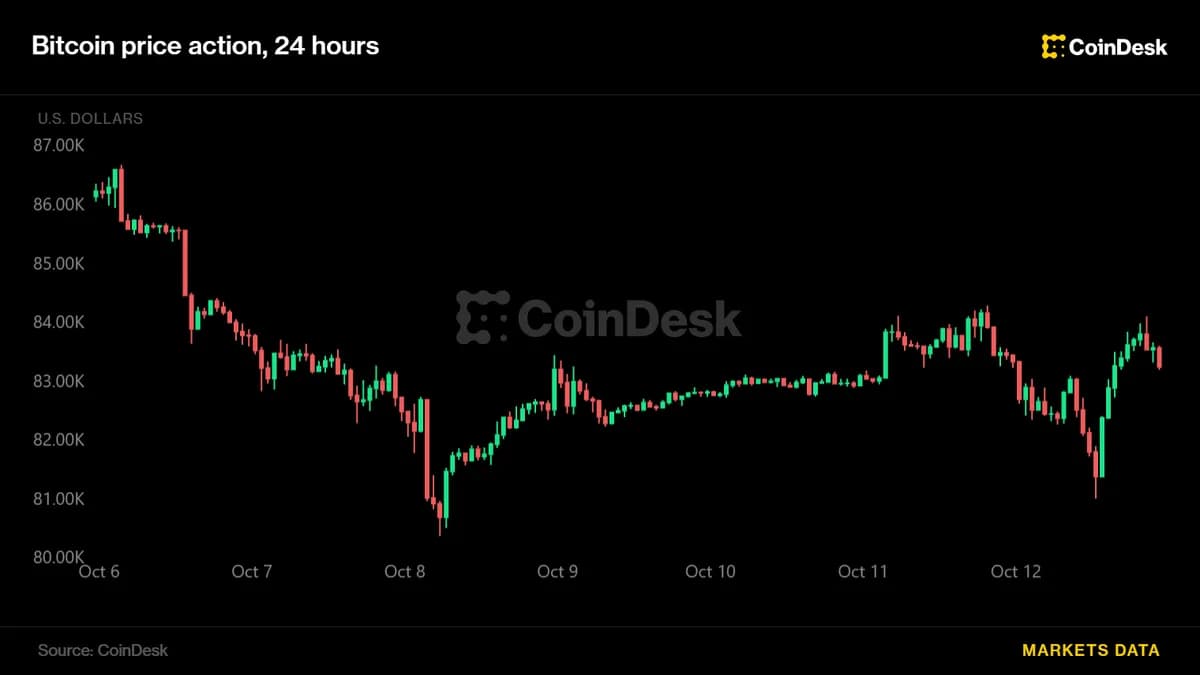
Bitcoin Rebounds Above $83,000 After Dropping Below $81,000 as KOSPI Plunges 5.5% on AI Worries
Bitcoin briefly dipped below $81,000 before rebounding above $83,000, while South Korea's market lost 5.5% under the pressure of AI concerns and Chinese competition. Detailed analysis of derivatives flows, U.S. inflation forecasts, and expected banking results.
Bitcoin briefly dipped below $81,000 before rebounding above $83,000 and closing slightly above that level, according to CoinDesk. Ethereum, on the other hand, hit a low of $2,400 before stabilizing at $2,512.20, reflecting extreme volatility in cryptocurrencies amid Asian equity market turbulence.
Bitcoin Rebounds Above $83,000 After Dropping Below $81,000
Bitcoin's (BTC) price reached $83,614.72 before briefly dropping below the psychological $81,000 mark, then rebounding above $84,000 before settling just above $83,000. This swing of over 2% in less than 24 hours highlights the sensitivity of the leading cryptocurrency to macro-financial developments. The movement was amplified by massive sell-offs in futures markets, which pushed liquidations to $813 million, a 284% increase from one day earlier (CoinDesk).
Meanwhile, Ethereum (ETH) saw its price drop to $2,400 before rebounding to $2,512.20, showing a milder but equally swift correction compared to Bitcoin. Both cryptocurrencies were driven by the same dynamic of trader disengagement, as evidenced by the taker long/short ratio flipping to 48%/52% (CoinDesk). This inversion indicates that sellers have regained control, even as buying pressure remains significant.
KOSPI Plunges 5.5% Amid AI Fears and Chinese Competition
South Korea's main stock index fell 5.5% in a single session, leaving the KOSPI around 38% below its June historical high, according to CoinDesk. Giants Samsung Electronics (005930) and SK Hynix (000660) led the decline, dropping 7% and 10%, respectively, amid growing concerns that massive investments in artificial intelligence could turn into a "casino-like" scenario, as referenced in an article citing Broadcom's CEO. This analogy underscores the perception of over-investment risk in the AI sector, where returns remain uncertain.
Meanwhile, technological advancements by Chinese memory chip company CXMT have fueled fears of increased competition, threatening the market share of established players like Samsung and SK Hynix. The negative sentiment quickly spread to other Asian stocks, triggering widespread selling that amplified volatility in derivatives markets linked to cryptocurrencies.
Futures Volumes Surge: $212B, Liquidations at $813M
Crypto futures trading saw a volume of $212 billion over the last 24 hours, up 66% from $126 billion the previous day (CoinDesk). This surge in volume reflects traders' appetite for short-term positions, even as open interest (OI) fell 1.58% to $143.4 billion, indicating a net disengagement of medium-term capital.
Massive liquidations, which jumped 284% to $813 million, reflect margin calls on highly leveraged positions. The taker long/short ratio, now at 48%/52%, marks a reversal from the previous day when longs held 52% of the flow, suggesting that buyers are less dominant and sellers have taken market control (CoinDesk).
U.S. Inflation Expected at 3.6% and Major Bank Results Fuel Volatility
Market participants expect U.S. headline inflation to come in at 3.6% year-over-year for the coming month, with underlying inflation seen at 2.5%, according to CoinDesk-cited forecasts. A figure in line with expectations would mark an acceleration from the 3.4% observed last month, strengthening pressure on Federal Reserve monetary policy expectations.
Meanwhile, JPMorgan Chase (JPM), Goldman Sachs (GS), and Citigroup (C) are set to release their third-quarter results, offering further insight into credit health and consumer demand. Investors are closely watching these earnings for resilience or weakness signals that could influence interest rate expectations and, by extension, the dynamics of risk assets, including cryptocurrencies (CoinDesk).
Technical Outlook: Bitcoin Holds at $83,000, Ethereum Stabilizes Near $2,512
Technically, Bitcoin found solid support around $83,000, holding firm despite initial selling pressure. CoinDesk technical analysts note that breaking this level could open the door to a new rally toward $86,000, while a retreat below $81,000 would test $78,000.
Ethereum, for its part, stabilized near $2,512.20, with immediate resistance around $2,560. A breakout above that could push the price toward $2,650, while a breakdown below $2,400 would signal a more pronounced decline. These technical levels, combined with derivatives flow data and macroeconomic volatility, provide traders with precise mapping to calibrate their positions (CoinDesk).
In conclusion, the current landscape illustrates how concerns over AI in Asia, U.S. inflation expectations, and sharp movements in derivatives markets can trigger rapid rebounds in cryptocurrencies. Investors will need to closely monitor volume indicators and corporate reports to adjust their strategies in real-time.