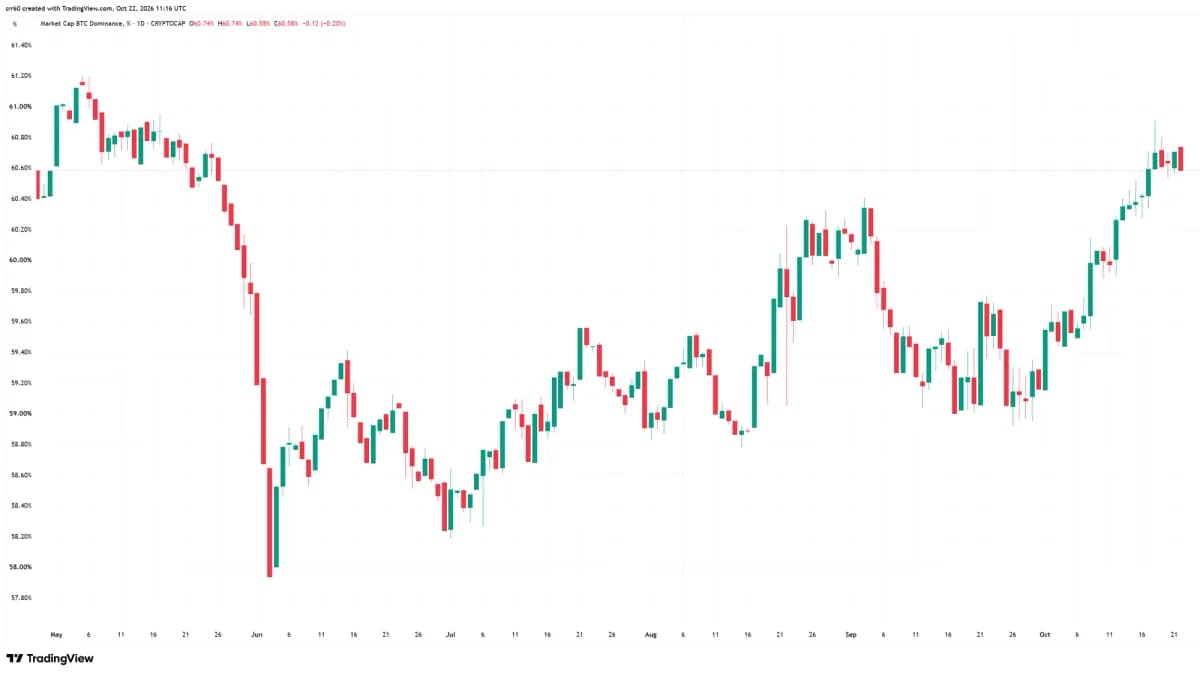
The cryptocurrency market has once again concentrated its capital around Bitcoin, the leading digital currency by market capitalization. At the time of writing, BTC trades at 84,459.46 $, a level that places Bitcoin's share of total sector capitalization at 60 %. This proportion represents the highest dominance rate since May 2026 and indicates that investors favor Bitcoin's relative stability over altcoins, whose performance is more volatile. The phenomenon occurs amid a broad price weakness, where participants seek protection against macroeconomic uncertainties.
Dominance Rate Mechanics and Recent Evolution
Bitcoin's dominance rate is calculated by dividing BTC's market capitalization by the sum of the capitalizations of all listed cryptocurrencies. Thus, a 60 % rate means that six out of ten parts of total market value are held by Bitcoin. This metric is often used as a barometer of investor confidence: a rise indicates a shift of funds toward the Bitcoin "safe haven," while a decline signals increased appetite for altcoins. Since the start of the year, dominance has hovered around 55 % before reaching the current peak, reflecting a capital rotation triggered by the fall of small tokens and a partial unwinding of risk positions.
Over a seven-day period, Bitcoin posted a marginal change, oscillating between $82,000 and $84,000. Ethereum, the second-largest cryptocurrency by capitalization, holds around 2,490.55 $, with little net movement. Other major assets like XRP and Solana (SOL) also displayed relative stability, trading in a slightly positive range. By contrast, Zcash (ZEC) stood out with a gain exceeding 10 %, making it the only major token to post notable performance over the same period. This divergence stems from project-specific dynamics, notably technical upgrade announcements or variations in demand on decentralized trading platforms.
Small Token Decline and Sector Indices
Smaller-capitalization assets saw steeper declines. The CoinDesk Memecoin Index fell more than 5 %, reflecting these tokens' extreme sensitivity to market sentiment shifts. Similarly, the Computing Select Index, which groups distributed computing projects, lost 3.5 %, and the DeFi Select Index, dedicated to decentralized finance protocols, recorded a 2.5 % loss. These figures reflect heightened aversion to projects perceived as riskier, with investors favoring Bitcoin's market liquidity and depth.
Macroeconomic Analysis and the Role of Bitcoin's Scarcity
Joel Kruger, market strategist at LMAX Group, notes that the previous period of crypto sector outperformance has given way to greater correlation with equity markets. Investors now await a "catalyst" capable of breaking this synchronization. According to Kruger, the global macroeconomic factor remains the primary driver, particularly monetary policy outlook and inflation indicators. He adds that Bitcoin's inherent scarcity – capped at 21 million units and subject to regular halvings – could serve as a shield against stock market turbulence, by offering a store of value uncorrelated with fiat currencies.
ETF Flow Volatility and Investment Recommendations
Vikram Subburaj, CEO of Indian platform Giottus, warns against the temptation to "chase Bitcoin rallies." He notes that cryptocurrency-linked exchange-traded funds (ETFs) remain characterized by highly volatile inflows and outflows. Sustained institutional inflows via ETFs can create durable upward pressure, while massive outflows can accelerate a correction. Subburaj therefore recommends that investors favor staggered entries, calibrate position sizes prudently, and closely monitor signals from both ETF flows and U.S. Federal Reserve (Fed) announcements. This approach aims to limit exposure to impulsive price moves and preserve capital over the medium term.
Implications of the Fed's Upcoming Interest Rate Decision
The U.S. Federal Reserve is set to meet next week to decide on its interest rate policy. Historically, a rate hike tends to strengthen the dollar, raise bond yields, and reduce appetite for risky assets, including cryptocurrencies. Conversely, a hold or rate cut can support equity markets and, by extension, crypto-assets perceived as yield alternatives. Industry participants are therefore closely monitoring the Fed meeting minutes, inflation forecasts, and economic growth indicators, as these elements directly influence capital flows into investment products such as Bitcoin ETFs.