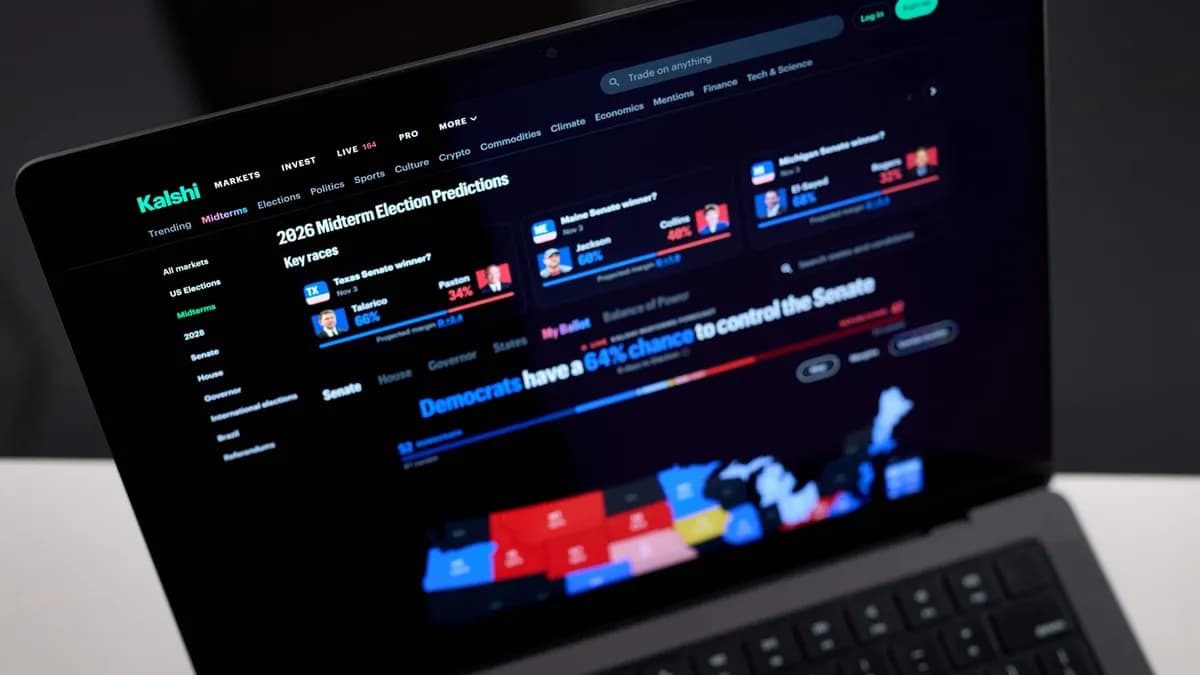
Millions of dollars circulating on prediction markets during the US election night
On November 3rd, 2026, platforms Kalshi and Polymarket recorded over two million dollars in transactions, with odds quickly shifting towards Democrats after early results from Indiana.
Millions of dollars circulated on prediction markets during the US election night of November 3rd, 2026, as odds rapidly realigned in favor of Democrats following early results from Indiana.
Over one million dollars traded on Kalshi's bet on Governor Greg Abbott's re-election
By 8 pm, at least one million dollars had been wagered on the Kalshi contract predicting the re-election of Texas Republican Governor Greg Abbott. The final result showed Abbott losing to Democrat Gina Hinojosa by over 700,000 votes, according to Associated Press.
This volume represents a significant portion of the total executive races transactions, highlighting traders' appetite for high-visibility events. Abbott's loss immediately caused the contract's probabilities to drop, confirming the market's reactivity to real-time data.
Over 1.4 million dollars wagered on Republicans not taking control of the House
By 11 pm, Kalshi participants traded over 1.4 million dollars on a contract stipulating that Republicans would not take control of the House of Representatives. This bet followed the confirmation of several key states leaning towards Democrats.
Capital movement strengthened the upward trend in probabilities for Democrats in similar contracts, demonstrating prediction markets' ability to rapidly integrate election results as they come in.
87% of prediction markets gave ≥90% chances to the winning candidate at least 24 hours before voting
A CNBC analysis found that 87% of election contracts on Kalshi and Polymarket offered at least 90% chances to the candidate who ultimately won each race, 24 hours before polls opened.
This high accuracy rate, far exceeding that of simple guesswork, shows aggregators successfully captured signals from polls and macro-political indicators before election day.
Experts judge prediction markets accurate but not superior to traditional polls
"I'd say prediction markets did pretty well," said Professor of Economics Koleman Strumpf of Wake Forest University, noting that markets didn't outperform the best traditional polls. This comes from an interview cited by CNBC.
Strumpf clarified that while markets offer real-time reads on expectations, they remain dependent on public information flows and aren't a substitute for classic opinion surveys.
Nate Silver notes convergence of market probabilities with his models
Forecaster Nate Silver, founder of Silver Bulletin, contested the idea that markets were outshining models by writing: "Prediction market probabilities strongly converged toward [our models] in individual Senate and gubernatorial races." This appears in his bulletin and reflects his role as advisor at Polymarket since 2024.
Silver indicated that movements in prediction markets were often driven by adjustments to his own models, creating an interactive dynamic rather than simple competition.
Sports betting volume continues to dominate, tripling since late October
Contracts related to sports remain dominant on platforms Kalshi and Polymarket; their volume has more than tripled between late October and midterms week, according to CNBC article data.
This dominance shows that, despite the enthusiasm for political events, prediction markets maintain a broader and more active user base around sports betting, influencing liquidity available for election contracts.