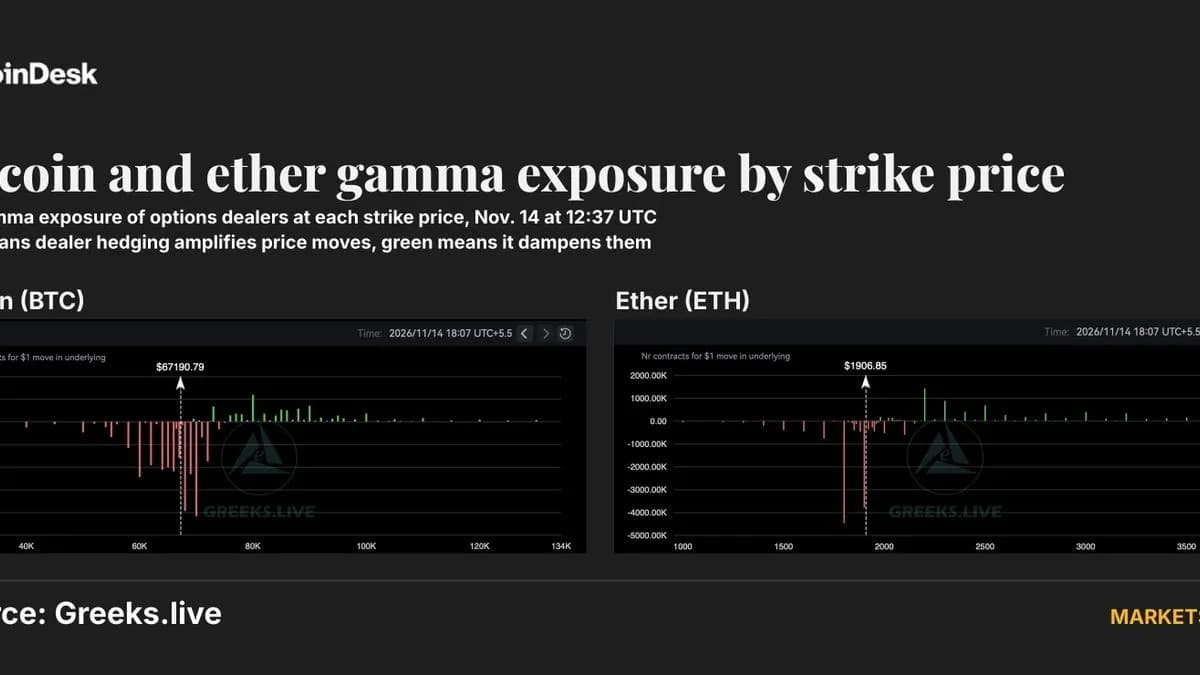
Negative Gamma of Market Makers: Increased Volatility for Bitcoin and Ether
Bitcoin at $67,384.80 and Ether at $1,797.90 are trading in a zone of negative gamma that pushes market makers to reinforce price movements. According to Greeks.Live, this dynamic could amplify volatility and trigger liquidations on futures contracts.
Bitcoin is trading at $67,384.80 and Ether at $1,797.90, but their prices are in a zone where market makers have negative gamma exposure, according to data from Greeks.Live published by CoinDesk on November 14, 2026. This configuration forces market makers to sell when prices fall and buy when they rise, which can exacerbate price movements. Both Bitcoin and Ether are experiencing this phenomenon, with their options largely negative. Analysts warn of potentially higher volatility in the coming days.
Dominant negative gamma for Bitcoin between $58,000 and $72,000
The GEX chart for Bitcoin shows negative gamma exposure across most of its current range, from around $58,000 to $72,000, according to Greeks.Live. This zone covers most recent transactions, including the $67,191 price recorded at 12:37 UTC on Saturday. In such an environment, market makers are net short gamma, encouraging them to sell during price drops.
Concentrations of negative gamma are around $68,000 and $70,000, where the GEX reaches its highest values. These levels are regularly crossed by Bitcoin's price, creating friction points where coverage sales intensify. The repeated nature of these concentrations increases the likelihood of rapid fluctuations each time the price crosses these marks.
Ether also in negative gamma territory
The options market for Ether follows a similar pattern, with a largely negative GEX across its current price range. Although the exact figures of the range are not detailed, Greeks.Live indicates that Ether's gamma profile mirrors that of Bitcoin, with concentrations of short-gamma around similar levels.
This negative exposure means that market makers on Ether are also pushed to sell during price drops and buy during price increases, reinforcing price direction. The symmetrical nature of negative gamma on both cryptocurrencies increases the risk of joint volatility.
Mechanism of short-gamma: Sell on the way down, buy on the way up
Short-gamma forces market makers to adjust their hedging positions in the direction of the market's movement. Thus, when a price falls, they must sell more underlying assets to stay hedged, exacerbating selling pressure. Conversely, during price increases, they buy, reinforcing bullish momentum.
"Both Bitcoin and Ether have slipped into deep negative gamma territory", explains Adam, macro researcher at Greeks.Live, cited by CoinDesk. He adds that "deep negative GEX means dealers are net short options—largely driven by traders bidding up downside puts or chasing breakout calls." According to him, market makers "must trade with the prevailing momentum, not against it", creating a vicious cycle of amplified volatility.
Impact on futures contracts: Risk of forced liquidations
Short-gamma doesn't stop at spot markets; it spills over into leveraged futures. Sudden movements triggered by hedging adjustments can cause forced liquidations of highly leveraged positions, further exacerbating price fluctuations.
Traders with margined positions on Bitcoin and Ether may see their positions automatically closed once movements exceed margin thresholds, resulting in additional sales that fuel price drops. This dynamic creates a systemic risk for trading platforms offering derivative products on these cryptocurrencies.
Transition to positive gamma above $73,000 could calm the market
Data indicates that above around $73,000, Bitcoin's gamma exposure becomes positive, encouraging market makers to buy during price drops and sell during price increases, potentially dampening volatility. This transition could offer a temporary cushion against extreme movements.
However, the transition to positive gamma is fragile; a rapid reversal of sentiment or a sudden influx of options can bring GEX back into negative territory. Market observers note that while the $73,000 threshold represents a potential support level, the situation remains sensitive to options flows and hedging strategies.