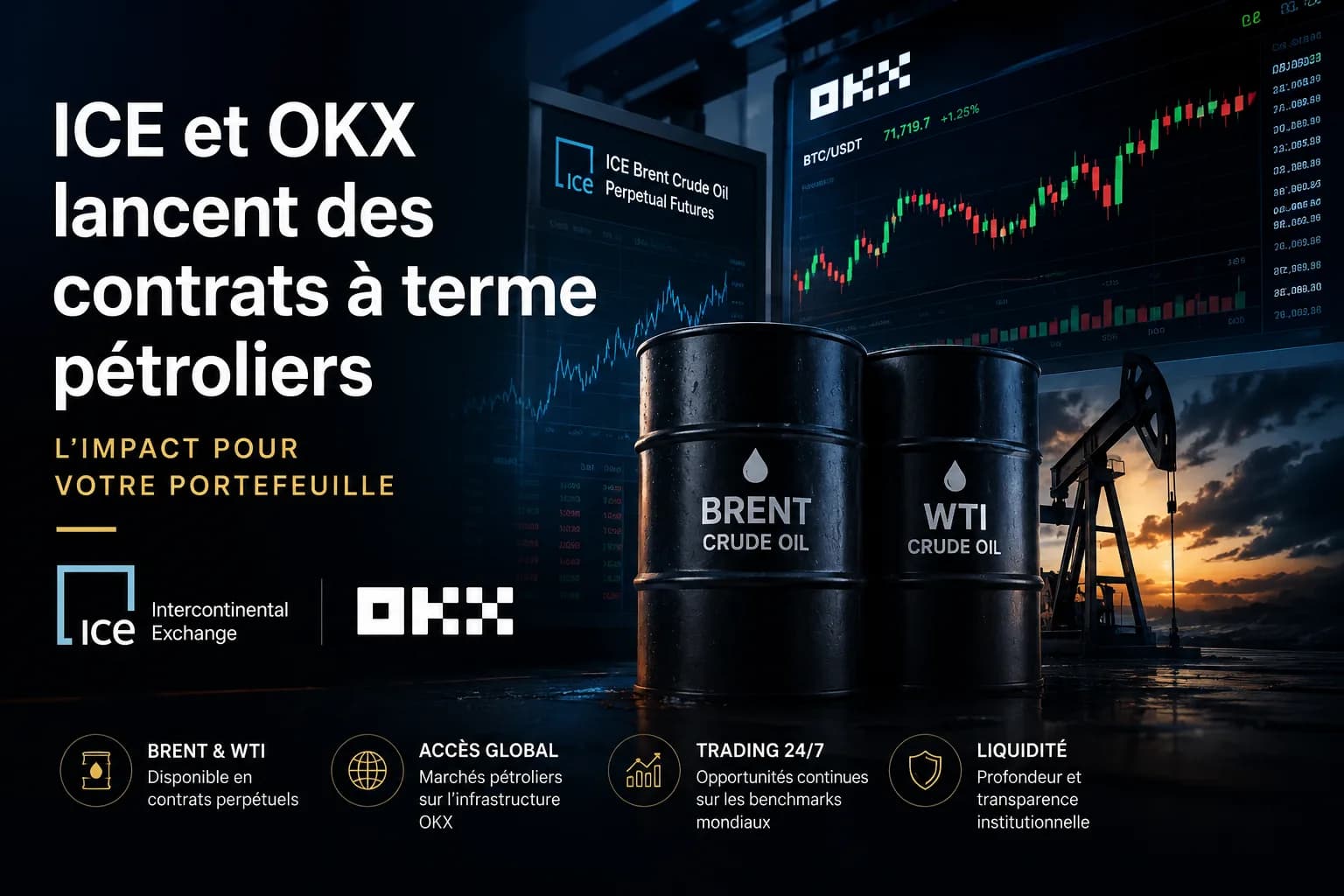
ICE and OKX Launch Oil Futures: The Impact on Your Portfolio
The New York Stock Exchange (ICE) is partnering with crypto platform OKX to launch oil futures contracts. This initiative blurs the lines between traditional finance and crypto, with implications that French investors should not overlook.
The world of finance is constantly evolving, and the boundaries between traditional markets and new technologies are blurring at breakneck speed. Proof of this is the announcement by Intercontinental Exchange (ICE), the owner of the New York Stock Exchange, of the upcoming launch of crude oil futures contracts, in partnership with cryptocurrency exchange platform OKX. This collaboration, which will allow trading of derivatives linked to Brent and WTI benchmarks, marks a significant step in the integration of digital assets within commodity markets, all while remaining under the watchful eye of regulators.
When the New York Stock Exchange Flirts with Cryptos
The announcement of this collaboration between ICE and OKX is far from trivial. ICE, a major player in global financial infrastructure, which notably manages the New York Stock Exchange, has decided to venture into the realm of cryptocurrencies and associated derivatives. The partnership aims to offer perpetual futures contracts on Brent and WTI oil, two global benchmarks for barrel prices. These financial instruments allow investors to speculate on the future evolution of oil prices without having to physically hold the commodity. The originality lies in the choice of partner: OKX, a well-established cryptocurrency exchange platform, which will bring its technological expertise and network to the world of digital assets.
This initiative is part of a broader trend of convergence between traditional finance and the cryptocurrency ecosystem. Major financial institutions are increasingly seeking to explore the opportunities offered by blockchain and digital assets, whether through investment products, underlying technologies, or strategic partnerships. For ICE, this means expanding its range of derivative products, capturing a new clientele, potentially younger and familiar with trading on crypto platforms, and strengthening its position in the commodities sector, a market essential for the global economy. The choice of oil as the underlying asset is not surprising, given its strategic importance and the volatility of its prices, which traditionally attract speculators and hedgers.
Why Are These Oil Futures Contracts Crucial for the Markets?
The launch of these oil futures contracts by ICE and OKX is of particular importance for several reasons. Firstly, it demonstrates the growing maturity of cryptocurrency-related derivatives and the willingness of traditional players to integrate them into their offerings. By partnering with a platform like OKX, ICE aims to provide a smoother and more accessible trading experience for instruments that, until now, may have seemed complex or reserved for an elite. The explicit mention of "licensing restrictions" also suggests that this initiative is part of a defined regulatory framework, a cautious approach aimed at reassuring investors and regulatory authorities.
Secondly, the integration of oil derivatives on a cryptocurrency trading platform could impact the volatility and liquidity of oil markets. The combination of ICE's expertise in managing futures markets and OKX's user base could potentially attract new capital flows into oil. This could also lead to increased correlation between oil price movements and those of cryptocurrencies, a phenomenon already observed to some extent during periods of high economic or geopolitical uncertainty. Investors will therefore need to closely monitor the interaction between these two distinct financial universes.
Finally, this announcement raises questions about the future of financial market and cryptocurrency regulation. As global authorities seek to more strictly regulate the digital asset sector, partnerships like this could either accelerate regulated integration or, conversely, complicate the landscape. The involvement of a major player like ICE, which is subject to strict regulatory constraints, could serve as a model for other future collaborations, demonstrating that it is possible to innovate while respecting existing legal frameworks. The success of this initiative will largely depend on its ability to attract sufficient trading volume while maintaining a secure and compliant trading environment.
For the French investor, this announcement is news to observe carefully, without necessarily prompting an immediate reaction. The offering will concern futures contracts, which are complex and highly leveraged instruments, generally reserved for informed or professional investors. It is unlikely that these new contracts will be directly accessible through mainstream products like the Plan d'Épargne en Actions (PEA) or life insurance in the short term, due to their nature and specific tax treatment. However, the evolution of these markets can have indirect repercussions on your portfolio.
What to do concretely?
Monitor oil volatility: Fluctuations in oil prices have a direct impact on inflation, transportation costs, and the performance of energy sector companies. If you hold shares in oil companies, such as TotalEnergies, or sector-specific ETFs, a significant rise or fall in barrel prices will directly influence their valuation. This new initiative could potentially increase this volatility.
Understand correlations: The integration of oil derivatives on crypto platforms could lead to a new form of correlation between commodity markets and digital asset markets. If you invest in cryptocurrencies through trading platforms, or potentially through crypto ETFs if they develop further in France, keep an eye on this emerging dynamic.
Diversify prudently: For the majority of French investors, the best approach remains diversification. If you wish to gain exposure to commodities, opt for broad and recognized ETFs, such as those replicating diversified commodity indices, accessible through your PEA or ordinary securities account (CTO). ETFs like the Amundi MSCI World CW8 ETF already offer indirect exposure to energy sector companies, as well as many other sectors, contributing to good overall diversification.
Direct investment via CTO: If you have an appetite for risk and a good understanding of derivative markets, you could consider accessing these products through an ordinary securities account (CTO) with a broker like Trade Republic or Degiro, provided these instruments are offered and you are eligible as a professional investor. The taxation of derivatives on a CTO follows the progressive income tax scale, after application of the holding period allowance for capital gains realized before 2018, or the single flat-rate levy (PFU) for capital gains realized after that date.
It is essential to remember that futures contracts are high-risk instruments. Leverage can amplify gains, but also losses dramatically. Before considering any investment in such products, a thorough analysis of your risk profile and a complete understanding of how these instruments work are essential. For retail investors, diversified ETFs and quality stocks remain the pillars of a solid and sustainable investment strategy.
Outlook: Towards Hybrid Finance?
This alliance between ICE and OKX could well be a prelude to a new era of finance, where the lines between traditional and digital definitively blur. ICE's ability to integrate oil derivatives on a cryptocurrency trading platform, while navigating a complex regulatory environment, paves the way for similar innovations in other asset classes. We can imagine platforms in the future offering diversified asset baskets including stocks, bonds, commodities, and cryptocurrencies, all managed through cutting-edge technological infrastructures.
The success of this initiative will be measured by adoption by traders and investors, as well as by the reaction of regulators. If it proves to be successful, it could encourage other major financial exchanges and cryptocurrency trading platforms to explore similar collaborations. This could, in the long run, make investing in traditional assets more accessible to users of crypto platforms, and conversely, offer new opportunities to traditional investors eager to explore the potential of digital assets, all, hopefully, within a clear and protective regulatory framework.
Disclaimer: This article is for informational purposes only and does not constitute investment advice. Investments in derivatives or cryptocurrencies involve significant risks of capital loss. It is recommended to consult a professional financial advisor before making any investment decisions.