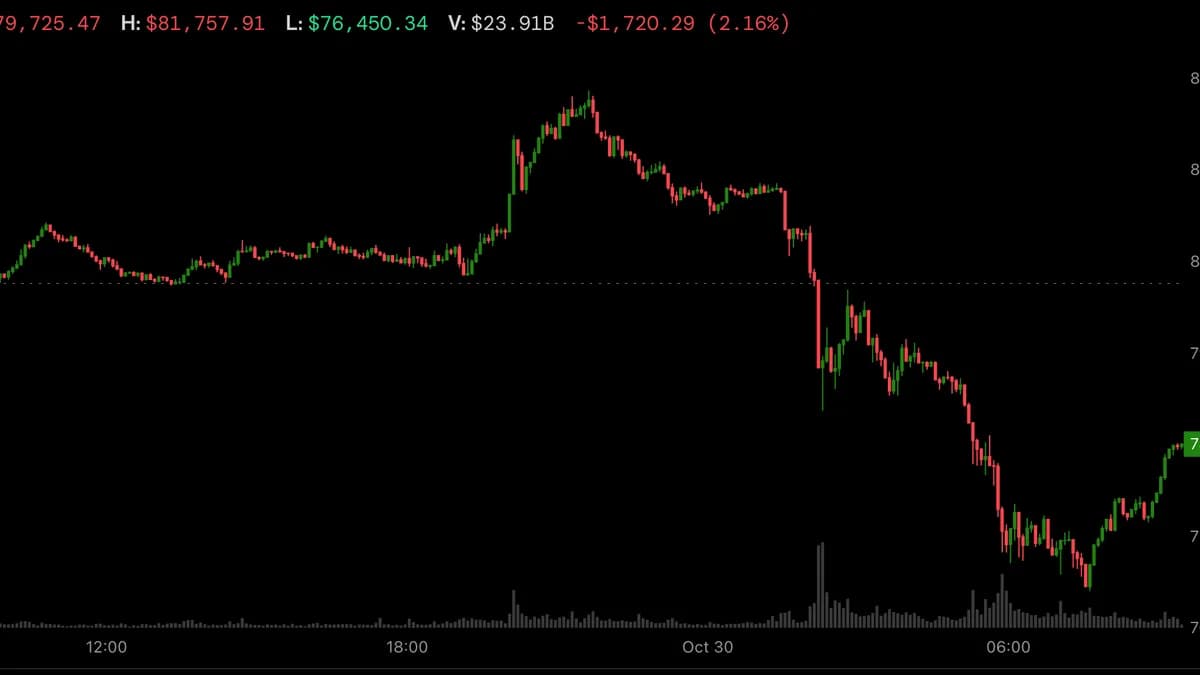
A $6 billion hack on Binance led to a drop in bitcoin and ether prices. Standard Chartered predicts a near-future decline.
Binance Hack Causes Cryptocurrencies to Plummet
The crypto community was shaken on October 30, 2026, by the announcement of a massive compromise of the Binance exchange platform, estimated at around $6.3 billion in digital assets. This loss represents more than four times the previous record hack, which was that of Bybit in 2025 ($1.5 billion) and was attributed to North Korea. The incident immediately triggered a wave of sales on major markets, leading to a significant drop in the price of Bitcoin and Ether, the two most capitalized cryptocurrencies.
Bitcoin, which was trading around $78,474.74, lost more than 3% in less than 24 hours, dropping to around $77,400 on Friday morning, with a temporary low that brought it close to $76,000. Ether, meanwhile, saw its price drop to $2,249.18, while the native token of Binance (BNB) fell to $714.35, and other assets such as XRP and Solana (SOL) also recorded noticeable but more modest losses.
Beyond the direct loss of funds, the hack had a domino effect on the derivatives market. Traders who held long positions on futures contracts, i.e., bets on future price increases, were particularly affected. At the time of writing, total market liquidations amounted to $1.5 billion, including $468 million from Bitcoin and $358 million from Ether. These figures reflect the speed at which stop-loss orders were triggered, forcing platforms to liquidate positions to protect their own balance sheets.
Standard Chartered Predicts Near-Future Decline
Banking giant Standard Chartered published an analysis predicting that cryptocurrency prices could remain under pressure for several weeks or even months before finding a stable floor. The bank notes that uncertainty surrounding the Binance hack, particularly the lack of clarity on the exact number of assets frozen or recoverable, is fueling investor nervousness. According to Standard Chartered, as long as the details of the hack remain unclear and frozen assets are not restored, markets will continue to suffer additional sales.
This pessimistic outlook is supported by several contextual indicators. Firstly, market liquidity has been significantly reduced by mass liquidations, making prices more volatile and sensitive to large sell orders. Secondly, the confidence of major players – notably investment funds, banks, and crypto lending platforms – has been shaken, limiting their appetite for new exposures. Finally, the rapid reaction of stablecoin issuers, who froze over $1.567 billion of USDT, shows that industry actors are taking precautionary measures that paradoxically may exacerbate liquidity contraction.
The Cryptocurrency Market in Distress
For several months, the cryptocurrency market has been evolving in a context of increased volatility, marked by regular price drops and a gradual loss of confidence among investors. This period of turbulence was amplified by two major events that occurred on the same day: the Binance hack and the exploitation of the prediction platform Polymarket, which saw over $2.6 million siphoned from user accounts. Although the amount lost on Polymarket was significantly lower than that of Binance, it contributed to a general sense of vulnerability within the ecosystem.
The underlying economic mechanism behind these price movements is primarily based on the interaction between spot markets and derivatives markets. On the spot market, investors buy and sell digital assets directly. On the futures market, they bet on the future direction of prices without actually owning the underlying asset. Long positions (betting on price increases) are financed by margins deposited, which serve as collateral. When the price of an asset drops sharply, margins may become insufficient to cover potential losses, triggering automatic liquidation orders. These liquidations generate additional selling pressure, exacerbating spot price declines and creating a vicious cycle.
In the case of the Binance hack, the drop in Bitcoin by more than 3% resulted in $468 million worth of long position liquidations, while Ether saw $358 million in liquidations. The total of $1.5 billion in liquidations represents a significant portion of the daily market volume, explaining why volatility has reached levels rarely seen since the major correction episodes of 2022-2023.
Futures Contract Liquidation Mechanism
Cryptocurrency futures contracts operate on a system of initial margin and maintenance margin. Initial margin is the capital that the trader must deposit to open a position, while maintenance margin represents the minimum level of capital that the trader must maintain to keep the position open. If the price of the asset moves unfavorably and the maintenance margin is no longer met, the platform's system automatically triggers a liquidation, selling the position at market price to cover losses.
This process is automated and executes in milliseconds, but it can temporarily disrupt order books. During a mass liquidation like that observed on October 30, the excess sell volume exceeds the capacity of buy orders, causing the price to drop rapidly. Traders who were initially long see their positions closed at a loss, while actors who take short positions can profit from the decline, further reinforcing the bearish dynamic.
Stablecoins' Reaction and Tether's Role
Stablecoins, notably Tether's USDT, play a crucial role in stabilizing the market by offering an 'stable' alternative to volatile assets. As soon as the hack was confirmed, Tether CEO Paolo Ardoino announced the freezing of over $1.567 billion worth of USDT linked to suspicious withdrawals. This freeze was implemented to prevent rapid conversion of these tokens into fiat currencies, which could have intensified selling pressure on spot markets.
Stablecoin freezing has two contradictory effects. On one hand, it protects honest users by limiting hackers' ability to convert stolen funds into real liquidity. On the other hand, it reduces the liquidity available for traders who want to hedge or rebalance their portfolios, increasing the volatility of underlying assets. This duality highlights the growing dependence of the crypto market on stablecoins while also underscoring the systemic risks associated with their concentration.
Implications for Decentralized Exchanges (DEX)
The Binance hack could accelerate a partial migration of users to decentralized exchanges (DEXs), which do not rely on a single point of control. On a DEX, funds remain in users' wallets, and transactions are executed via smart contracts on the blockchain. This architecture reduces the risk of a single point of failure, such as a compromised engineer's computer, which was likely the cause of Binance's hack according to the platform's statements.
However, migrating to DEXs is not without challenges. DEXs typically offer less liquidity than centralized platforms, which can result in significant slippage on large orders. Additionally, security responsibility falls entirely on the user: losing a private key is irreversible. Thus, while DEXs are perceived as safer from a governance perspective, they introduce new risk management requirements for participants.
Political and Regulatory Context Analysis
The hack occurs at a time when global authorities are intensifying their scrutiny of the crypto sector. After the Bybit hack in 2025, several jurisdictions, including the United States and the European Union, proposed stricter regulatory frameworks regarding exchange platform cybersecurity. The magnitude of the $6.3 billion loss on Binance could push regulators to impose more stringent compliance requirements, such as independent security audits, higher capitalization requirements, and real-time incident reporting obligations.
Moreover, Standard Chartered's reaction, which emphasized that prices could remain under pressure, reflects increased caution among traditional financial institutions regarding the crypto sector. Banks considering integrating crypto trading or custody services may delay their plans until the regulatory framework becomes clearer and security risks are mitigated.
Impact on Institutional Investors
Investment funds and asset management firms that had already allocated a portion of their portfolios to cryptocurrencies are seeing their exposures decrease rapidly. The loss of over $1 billion in Bitcoin and Ether liquidations means that long positions, often used as inflation hedges or diversification, have been significantly impacted. Asset managers, mindful of protecting their investors, are likely to reduce or suspend their crypto exposure strategies, at least in the short term.
Furthermore, the perception of sovereign risk has evolved. Institutional investors now evaluate counterparty risk not only based on the platform's financial solidity but also its resilience against cyber-attacks. Binance, despite remaining one of the largest platforms, will need to demonstrate rapid and transparent recovery capacity to regain institutional actors' trust.
Persistent Bearish Sentiment
The market sentiment, measured by indicators such as the Fear & Greed Index, has shifted strongly towards fear following the hack. Volatility indicators (crypto VIX) have reached levels not seen since the 2022 crisis, reflecting uncertainty about the sector's ability to protect user funds. This fear translates into increased risk aversion, pushing investors towards safer assets like fiat currencies or government bonds at the expense of cryptocurrencies.
In summary, Binance's $6.3 billion hack triggered a cascade of events: Bitcoin and Ether price drops, massive derivatives market liquidations, stablecoin freezes, and institutional risk re-evaluation. Standard Chartered analysts predict that these pressures will persist until frozen assets are released and enhanced security measures are implemented. The crypto landscape could thus undergo structural transformation, potentially seeing a partial shift towards decentralized exchanges, while remaining under the watchful eye of regulators and institutional investors.