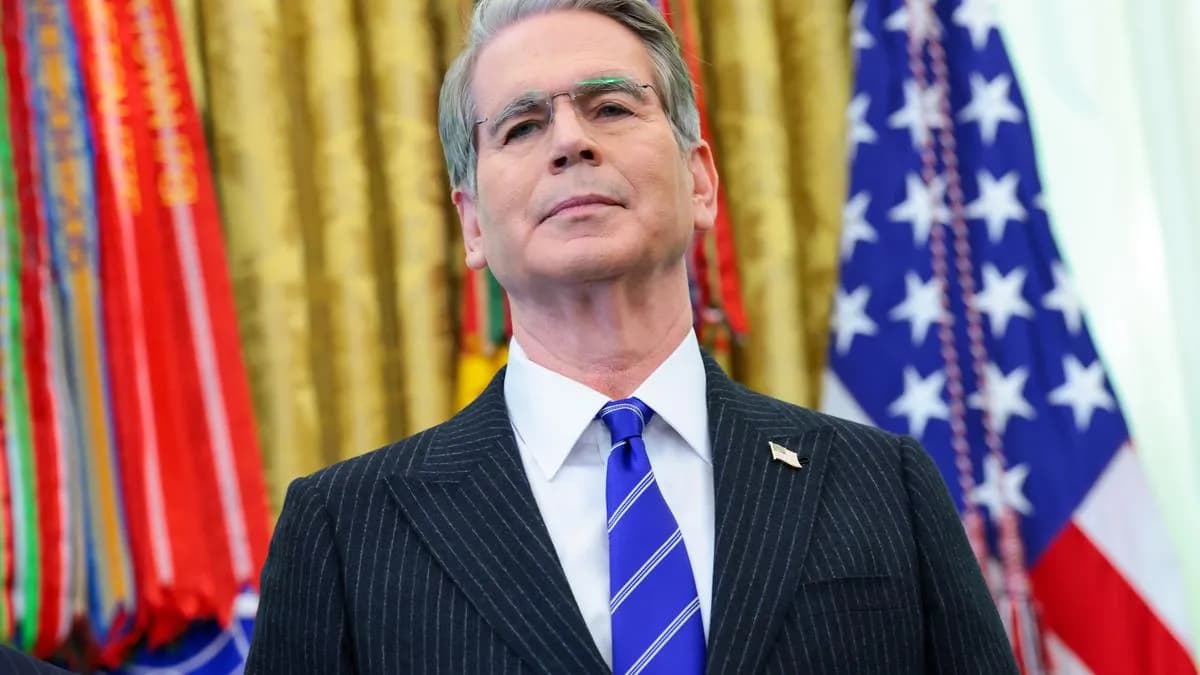
Scott Bessent, Treasury Secretary, stated at the Ripple conference that the US digital asset strategy, backed by the GENIUS Act, aims to strengthen the dollar's role against Chinese technological competition, relying notably on stablecoins predominantly backed by the US currency.
At the Ripple Swell conference, US Treasury Secretary Scott Bessent asserted that cryptocurrency will become the United States' primary instrument for maintaining the dollar's dominance on a global scale. This statement comes as Washington policymakers seek to consolidate the US monetary advantage against China's rising power and the emergence of a global digital ecosystem that is redefining capital flows, foreign exchange reserves, and cross-border payment mechanisms.
The Treasury sees crypto as a shield for the dollar
Bessent explained that while military power has long underpinned currency reserves, "we will keep our military umbrella, but I think increasingly it becomes a technological umbrella." This analogy underscores the shift from a paradigm centered on force projection capacity to a model where technological superiority, particularly in payment infrastructure and distributed ledger protocols, becomes the decisive factor of economic influence. In this vision, the "digital asset stack" – the ensemble of protocols, standards, custody services, exchange platforms, and payment networks that underpin digital assets – constitutes a new geostrategic competitive arena.
The Secretary detailed that mastery of this technology stack would allow the United States to shape the rules of the game, impose compliance standards, and secure access points to liquidity. In practice, this means US financial institutions, cloud service providers, and financial technology (FinTech) companies could become the reference providers for digital asset conversion, settlement, and custody services, creating a structural dependence of global actors on the US dollar.
This strategic orientation is also reflected in Bessent's remarks on technological rivalry with China. He recalled that countries and companies are today forced to choose between US or Chinese artificial intelligence and semiconductor ecosystems. Similarly, the choice of payment network and settlement protocol – whether based on US standards or foreign alternatives – will influence the dollar's reach in cross-border exchanges.
The GENIUS Act creates the first federal framework for stablecoins
The Trump administration has already enacted the GENIUS Act, legislation that establishes a dedicated federal regulatory framework for stablecoins, cryptocurrencies whose value is pegged to a fiat currency. The legislative text imposes transparency requirements on reserves, reporting obligations to financial authorities, and governance rules aimed at preventing money laundering and terrorist financing. By requiring issuers to hold reserves in US dollars or Treasury securities, the GENIUS Act creates a direct link between each stablecoin unit and the US sovereign liability.
According to Bessent, this legislative measure aims to expand global demand for dollars and Treasury securities by providing stable access to the US currency in countries facing high inflation or significant currency fluctuations. Concretely, when a user in an emerging economy purchases a dollar-backed stablecoin, they exchange their local currency for a digital unit guaranteed by dollar reserves. This operation generates demand for real dollars which, in turn, feeds US bond markets, strengthening the Treasury's ability to finance its budget deficit at favorable borrowing costs.
The mechanism amplifies when stablecoins are used as a payment method in cross-border trade. Each transaction involves a conversion, often via liquidity platforms, that mobilizes US dollars to settle exchanges. Thus, the mere fact of using a stablecoin as a reference currency creates a continuous flow of dollars toward US financial markets, increasing the dollar's share in central bank and international financial institution foreign exchange reserves.
SEC and CFTC mobilized to fill the regulatory void
The Treasury Secretary indicated that the Treasury Department will work with the Securities and Exchange Commission (SEC) and the Commodity Futures Trading Commission (CFTC) to clarify the rules applicable to cryptocurrencies, thereby filling the legislative gap left by the failure of the Clarity Act. The Clarity Act, initially proposed to establish a unified federal framework, was not adopted due to political divergences and industry pressure. This gap has left sector players exposed to legal uncertainties, particularly regarding token classification (security vs. commodity) and exchange platform oversight.
By collaborating closely with the SEC, the Treasury seeks to define qualification criteria for token offerings, establish financial disclosure requirements, and strengthen secondary market surveillance mechanisms. In parallel, cooperation with the CFTC aims to regulate crypto-asset derivatives, guarantee futures contract transparency, and prevent price manipulation. This dual approach covers the entire lifecycle of a digital asset, from issuance through trading and its use as collateral.
An essential component of this cooperation concerns the fight against "de-banking" – the cutting off of banking services to crypto sector companies. In Europe and the United States, several banks have restricted or suspended exchange platform accounts, citing compliance risks. Bessent emphasized that establishing regulatory safeguards, notably minimum capital requirements and service agreements with licensed payment institutions, could reduce the risk of sudden banking service withdrawal, ensuring operational continuity for US and international companies.
Stablecoins, over 90% dollar-backed, as a vector of influence
Bessent recalled that over 90% of stablecoins are backed by the US dollar, their issuers typically holding dollar reserves to guarantee parity. This dominance reflects market confidence in the dollar's stability and the depth of the US financial system. Each stablecoin, whether USDC, USDT, or other projects, rests on a portfolio of dollar or Treasury reserves that ensures 1:1 convertibility.
This dollar preponderance in stablecoins would allow the United States to extend its monetary influence, each digital transaction reinforcing dollar usage in economies where the local currency is unstable. For example, in an economy facing hyperinflation, citizens may turn to a dollarized stablecoin to preserve their savings' value. This capital migration toward dollar-backed assets increases demand for real dollars, which translates into higher foreign exchange reserves held by foreign central banks and, ultimately, greater Treasury capacity to issue debt at attractive rates.
Moreover, the concentration of stablecoins around the dollar creates a network effect: the more users and transactions increase, the more the marginal cost of dollar access decreases, reinforcing the dollar's position as the "reference numeraire" in the crypto ecosystem. This phenomenon can also influence monetary policy decisions, as a growing share of the global money supply circulates in digital token form, increasing the dollar's sensitivity to technological and regulatory shocks.
Implications for global financial markets
By combining the GENIUS Act framework, SEC and CFTC support, and the stated determination to dominate the technology stack, the United States creates an environment favorable to capital flows toward dollar-denominated digital assets. This regulatory and technological synergy encourages institutional investors to allocate a portion of their portfolios to stablecoins, liquidity funds, and crypto-asset-linked derivatives, while benefiting from enhanced legal protection.
Analysts anticipate this dynamic could support demand for US Treasury securities, while increasing crypto market volatility as investors seek to profit from the preference for dollar-backed stablecoins. In practice, rising dollar demand to collateralize stablecoins translates into upward pressure on short-term bond yields, as investors seek safe, liquid placements to provide the reserves required by the GENIUS Act. Simultaneously, increased liquidity on crypto trading platforms fuels record volumes, which can amplify price movements of non-stablecoin assets such as Bitcoin or Ethereum, often used as hedges or additional yield sources.
Furthermore, coordination between the Treasury, SEC, and CFTC creates a compliance framework that could reduce regulatory fragmentation risks between the United States and foreign jurisdictions. This harmonization facilitates foreign actor access to US markets while maintaining strict control over high-risk activities such as illicit financing or market manipulation. The expected result is greater transparency, better investor protection, and consolidation of the dollar as an anchor of stability in a rapidly evolving financial landscape.
"We're going to win in the digital asset stack, and that will continue to fortify the dollar," Bessent concluded, underscoring the geostrategic dimension of US crypto policy. This statement summarizes the vision of a government that, leveraging technology, regulation, and financial infrastructure, seeks to transform cryptocurrency into an additional lever of economic power, thereby consolidating the dollar's role as the world's reserve currency in the digital age.