U.S.-listed funds dedicated to spot bitcoin have taken in $1.08 billion in three days, revealing renewed institutional interest. Yet flows remain far from the $200 billion daily average that fueled previous rallies, leaving the next bitcoin price surge uncertain.
U.S.-listed exchange-traded funds (ETFs) dedicated to spot bitcoin recorded more than a billion dollars in inflows in just three days, a sign of renewed institutional interest but at a pace still well below the levels that have historically fueled the crypto-asset's most significant rallies.
Bitcoin ETFs Capture $1.08 Billion in Three Days
According to SoSoValue data, U.S.-listed spot bitcoin ETFs attracted $1.08 billion over the week, an average of more than $350 million per day. While notable, this influx does not surpass the peaks seen during previous bull cycles, when daily flows often exceeded the $500 million mark and, on several occasions, reached $1 billion. The current inflow volume therefore represents roughly half the average level observed during the three strongest rally periods since the products launched in January 2024.
The ETF creation mechanism partly explains this impact on bitcoin's price. When an institutional investor subscribes to shares of a spot ETF, the fund manager must buy the underlying bitcoin to ensure parity between the ETF's net asset value (NAV) and the crypto-asset's market price. Each new subscription thus generates real demand on the spot market, translating into direct upward pressure. Conversely, ETF redemptions trigger the sale of held bitcoin, creating downward pressure. Thus, the size and consistency of ETF flows are key indicators of supply and demand dynamics on the spot market.
« Institutional demand is showing a tentative improvement. However, flows remain volatile, and sustained inflows are needed to confirm a stronger recovery, » said Vikram Subburaj, CEO of Giottus, in an email to CoinDesk. His comment underscores that, while institutional appetite is present, it remains contingent on the stability of inflows, which today remains highly irregular.
Flow History: Over $200 Million in Average Daily Inflows During Previous Rallies
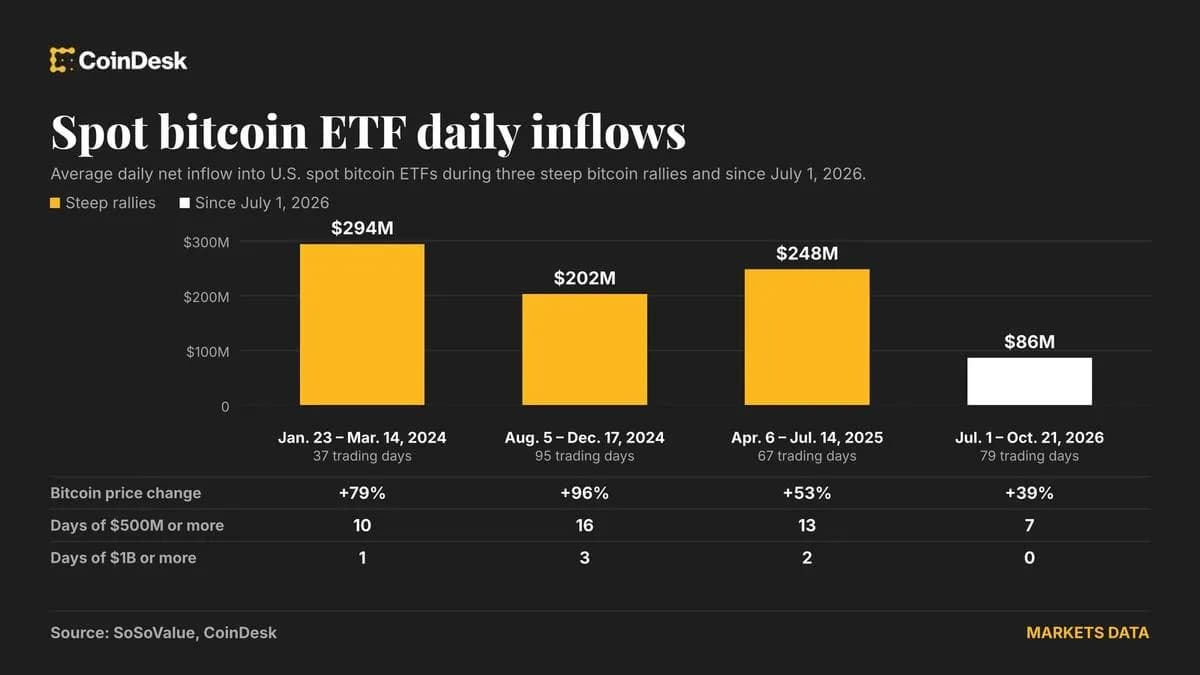
Since the ETF launch in January 2024, three major rallies have been accompanied by average daily inflows exceeding $200 million. The first, from January 23 to March 14, 2024, saw bitcoin climb 79% (from $39,900 to $71,400). During this period, ETFs recorded an average of $294 million in daily inflows, with ten days exceeding $500 million and one exceptional day where inflows surpassed $1 billion. This peak reflects the first wave of institutional acceptance following the SEC's approval of the first spot ETFs.
The second rally, from August 5 to December 17, 2024, was even more spectacular: bitcoin's price advanced 96% (from $54,100 to $106,100). Average flows reached $202 million per day, with sixteen days where inflows exceeded $500 million and three days above $1 billion. This period coincided with a favorable macroeconomic environment, notably a stabilization of U.S. interest rates that freed up additional capital for digital assets.
The third rally, from April 6 to July 14, 2025, generated a 53% gain (from $78,400 to $119,900). Average inflows reached $248 million per day, with thirteen days above $500 million and two days surpassing $1 billion. This phase was marked by an increase in hedging strategies via bitcoin futures contracts, which bolstered overall market liquidity and supported the price ascent.
These three episodes show a recurring correlation between sustained ETF flows (averaging above $200 million) and bitcoin price rallies of more than 50%, while keeping volatility in check (drawdowns never exceeded 20% from the peak). The contrast with the current situation is therefore striking.
Since July 1, 2024, bitcoin has advanced 39%, rising from around $60,000 to $83,500, reaching $84,459.46 at the time of writing. This gain has been accompanied by a frequency of large flows significantly lower than during rally periods. Over the same period, ETFs recorded only seven days with more than $500 million in inflows—one in eleven trading days—versus one in five during the three previous rallies.
This scarcity of large inflows underscores the fragility of current institutional support. The average daily level since July 1 stands at $86 million, well below the $200 million observed during historical rallies. Flow volatility also translates into more timid price moves: daily gains are often limited to a few percent, and corrections, while less severe than during bubble phases, remain more frequent.
It should be noted that ETF flows are not the sole driver of bitcoin's price. The market remains sensitive to futures volumes, direct purchases by sovereign wealth funds or family offices, and regulatory announcements. Nevertheless, the leverage effect created by ETFs—which compel managers to acquire the underlying—remains the factor most immediately translatable into buying or selling pressure on the spot market.
Current Flow Analysis: $86 Million Daily Average, Seven Days > $500 Million
Since July 1, the daily inflow average stands at just $86 million, well below the $200 million observed during historical rallies. This volume gap reflects heightened flow volatility, as Subburaj notes. Institutional investors remain cautious: flows occasionally hit the $500 million threshold but fail to sustain it, limiting the market's ability to support a sustained uptrend.
The inflow profile also shows temporal concentration. The seven days exceeding $500 million occurred primarily around announcements of new fund approvals or favorable quarterly performance reports. Outside these events, flows quickly fall back below the $100 million mark, indicating that demand is not yet anchored in a recurring fashion.
Another factor to consider is the role of bitcoin futures contracts, which, while not captured in ETF figures, influence risk perception and institutions' propensity to invest via listed funds. When futures prices trade at a positive premium to spot, ETF managers may be incentivized to buy more bitcoin to hedge their positions, thereby amplifying inflows. Conversely, a backwardation situation (negative premium) can discourage additional purchases.
Outlook: The Need for Sustained Inflows for a New Rally
Analysts agree that, to replicate the 50% to 80% gains seen previously, ETFs would need to record average daily inflows exceeding $200 million over an extended period. Without this level, prices risk stagnating despite recent gains. This requirement rests on the ability of flows to create continuous demand that exceeds available supply on the spot market, especially in a context where new bitcoin production from mining follows a predictable schedule and existing reserves are already largely held by institutional players.
In practice, as long as flows remain around $86 million daily, bitcoin may advance moderately, but a true rally will require a return to inflow momentum similar to the 2024‑2025 periods, when massive inflows fueled the strongest gains. The trigger for such a recovery could come from several sources: a new wave of approvals for spot-linked derivative products, further clarification of U.S. regulation that would reassure fund managers, or a macroeconomic environment where bond yields remain low, making digital assets more attractive for portfolio diversification.
Moreover, the ETF creation‑redemption mechanism implies that every new dollar invested translates into a real bitcoin purchased on the market. Thus, a sustained rise in subscriptions creates a snowball effect: the higher bitcoin's price rises, the more managers are incentivized to buy to maintain parity, which in turn fuels the price. Conversely, if subscriptions run out of steam, managers may be forced to liquidate positions to meet redemption requests, amplifying downward pressure.
In summary, the recent $1.08 billion influx over three days represents an encouraging step, but it remains well below the historical thresholds that have historically triggered bitcoin's strongest rallies. The future trajectory will therefore depend on institutional investors' ability to maintain regular and substantial inflows, as well as on the evolution of the regulatory framework and macroeconomic conditions that influence the propensity to allocate capital to crypto‑assets.