Ethereum Liquidations Reach $356M, Six Times Bitcoin’s Rate, During $1B Crypto Flush
In 24 hours, Ethereum positions saw $356M liquidated—six times more than Bitcoin despite a much smaller market cap. The crypto market witnessed over $1B in long positions evaporating amid geopolitical tensions, rate hike fears, and AI warnings.
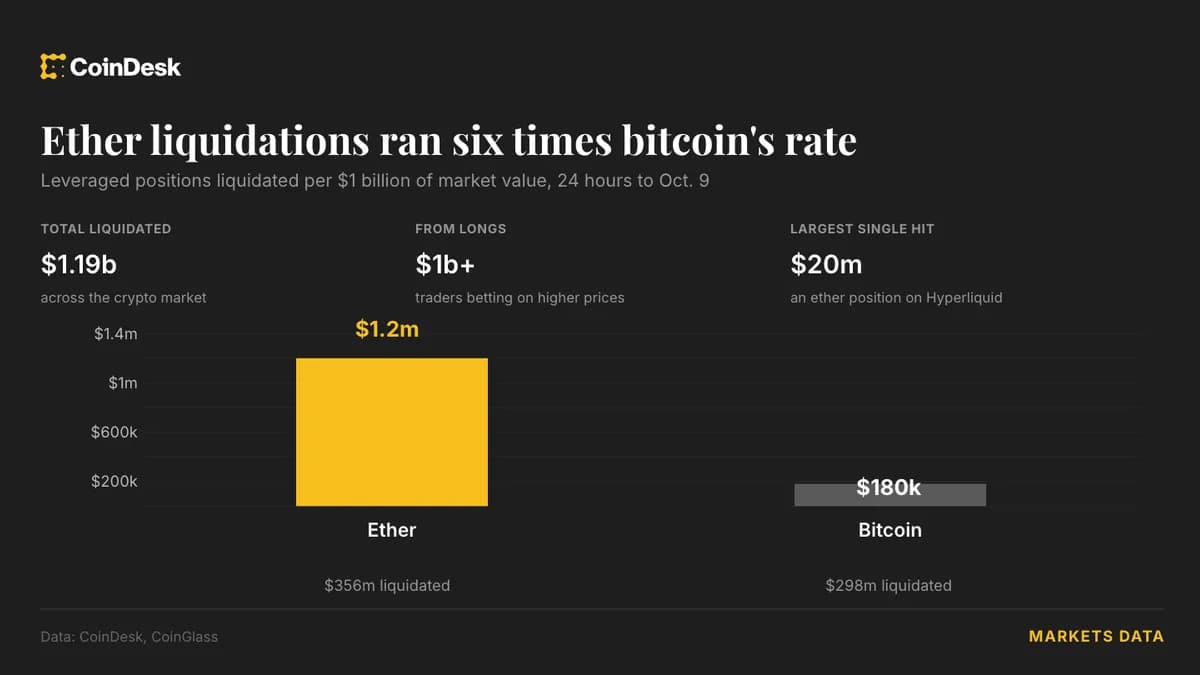
Ethereum traders saw approximately $356M in positions liquidated in 24 hours, more than the $298M in Bitcoin liquidations, despite Ethereum's market cap being less than a fifth of Bitcoin's. This apparent discrepancy is explained by a combination of higher leverage on decentralized platforms and an especially unfavorable macroeconomic context.
The total crypto market liquidations reached $119M over the same period, with more than $1B coming from long positions, according to CoinDesk. This concentration of losses on long positions indicates that most players are betting on prices continuing to rise but quickly find themselves at the mercy of sharp price movements that trigger platform auto-close mechanisms.
Ethereum Liquidations Six Times Higher Than Bitcoin's
Measured by size, Ethereum losses amounted to roughly $1.2M for every $1M of market value, compared to just $180k for Bitcoin. This disparity reflects the very high leverage used on decentralized platforms, where traders can borrow multiples of their collateral's value to increase their exposure.
The liquidation mechanism kicks in when a leveraged position incurs losses that erode the initial collateral. Once the margin ratio falls below a predefined threshold, the protocol automatically closes the position, often by selling the asset on the market. This forced sale adds downward pressure, creating a snowball effect that can impact other traders whose positions are also overcollateralized.
The largest single collapse involved a ~$20M position on the DEX Hyperliquid, where an entire trade was entirely liquidated, illustrating the vulnerability of large bets on Ethereum. In relative terms, this liquidation represented approximately 0.56% of Ethereum's total market cap at the time, but it generated notable price impact due to the speed at which the DEX had to absorb the trade size.
Macro Pressures: Interest Rates, Middle East Tensions, and AI
The Fed minutes, released Thursday, indicated that a majority of officials expected another rate hike by year-end. Rising interest rates increase the cost of financing, directly impacting leveraged positions as traders must pay interest on borrowed funds. In an environment where financing becomes more expensive, traders' room for maneuver decreases, making liquidations more likely at the first signs of market reversal.
Meanwhile, a report on the Pentagon's preparation for a potential conflict with Iran sent oil prices soaring, heightening uncertainty. Financial markets, including crypto assets, often respond to increased geopolitical risk by seeking safer perceived havens or liquidating risky positions. This dynamic amplified volatility, pushing traders to reduce their exposures or trigger automatic stop-losses.
A third factor, less tangible but equally feared, was Justin Drake's warning—a Ethereum researcher—who said AI could "break the mathematics securing crypto wallets." While this threat remains theoretical, it was enough to fuel nervousness among leveraged actors, who fear potential flaws could make their collateral less reliable.
Aggressive Longs Absorb Over $1B in Liquidations
Of the $119M in liquidations, over $1B came from long positions, meaning traders betting on price increases. This dynamic amplified forced sales, as each liquidation added extra selling pressure, exacerbating downward momentum. Long positions are typically more exposed to sharp price fluctuations, as they rely on the continuation of an uptrend to cover interest and funding costs.
Short positions, on the other hand, generated roughly $25M in liquidations over four hours, primarily after Trump's statement excluding a strike against Iran before midterm elections. This announcement temporarily eased geopolitical fears, causing Bitcoin to rebound quickly and reducing the need for short coverage, leading to the liquidation of positions that could no longer maintain their margins.
Impact on Prices: Ethereum -3% to $2,490, Bitcoin -1% Then Rebound
Following the wave of liquidations, Ethereum dropped over 3% to around $2,490. The 3% decline, translating to a $75M market cap loss in one day, highlights the asset's sensitivity to margin imbalances. Bitcoin, more resilient due to its five-times larger market cap, fell nearly 1%, dropping from $83,200 to around $80,400 before rebounding to $82,200 after Trump's announcement.
The Bitcoin rebound limited total losses but persistent volatility shows how sensitive crypto markets remain to external shocks and margin movements. The fact that Bitcoin managed a quick recovery suggests institutional actors, who hold the bulk of liquidity, stepped in to absorb forced sales, while Ethereum—more dependent on individually leveraged traders—faced sustained pressure.
AI Warning: Risk of Breaking Crypto Securities
Justin Drake reminded that AI could "break the mathematics securing crypto wallets" sooner than expected, adding another layer of concern among leveraged traders. While the risk remains speculative, it rests on the growing ability of AI models to identify vulnerabilities in hashing algorithms or optimize side-channel attacks. In a market where confidence in underlying security is a fundamental pillar, even perceptions of vulnerability can trigger mass sell-offs.
This warning contributed to the liquidation frenzy, with actors fearing that AI flaws could make overcollateralized positions even more vulnerable. Decentralized platforms, which lack the same centralized risk management capabilities as traditional exchanges, are thus exposed to scenarios where confidence erodes quickly, accelerating the liquidation process.
The data shows that excessive bets on Ethereum, combined with an unfavorable macro context, can lead to disproportionate losses. Traders must monitor not only price indicators but also monetary policy signals, geopolitical developments, and technological advancements likely to impact protocol security. A prudent approach involves calibrating leverage ratios based on expected volatility and the depth of the DEX order book used.
Finally, Drake's alert underscores the importance of rigorous risk management, particularly in limiting exposure to leverage on assets whose security could be compromised by rapid technological advances. Diversifying exposures, placing more conservative stop-losses, and favoring platforms with more transparent margin mechanisms are practices that can reduce the likelihood of a complete "wipeout" like the one that occurred on Hyperliquid.