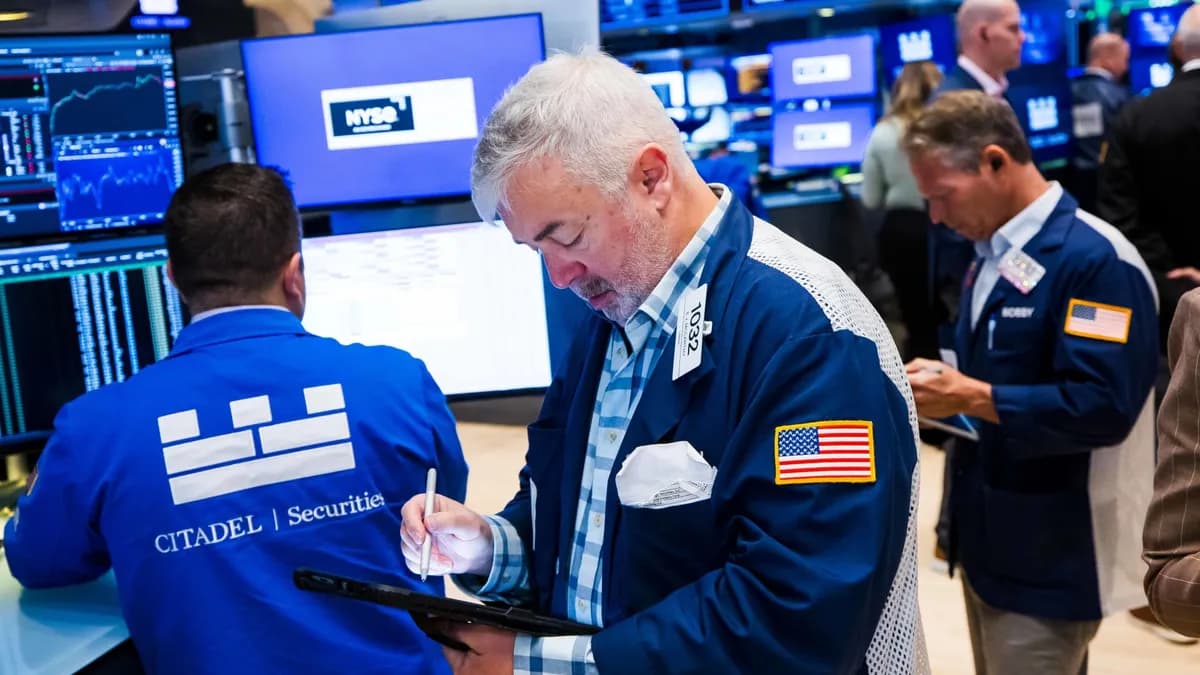
The Nasdaq-100 has been trading in a range between 27,200 and 31,000 since May. Investors are waiting for a signal to determine if the market is ready to break out of this range.
Nasdaq-100 Awaits Signal
The Nasdaq-100 is currently stuck within a relatively narrow price range, oscillating between 27,200 and 31,000 points. This trading range has been in place since May, when the last notable directional movement occurred. Since then, every attempt to break above or below the upper or lower bounds has resulted in rejection or rapid retracement. This dynamic creates a situation of 'range trading' where investors await a clear signal - a close above 31,000 or below 27,200 - to confirm a breakout and the start of a new trend.
The persistence of this range reflects the delicate balance between supply and demand on the tech segment of the market, but also the influence of macroeconomic and geopolitical factors that modulate market expectations.
Context: Persistent Uncertainty
The current climate is traversed by a series of variables of uncertainty that make any univocal reading of the market difficult. On the geopolitical front, international tensions - although not detailed in the brief - keep investors cautious as they can affect tech supply chains and capital flows. Domestically, the midterm elections in the United States introduce an additional political risk: a change of majority in Congress could influence budgetary policy, public spending, and regulations on the tech sector.
Moreover, the tech sector is shaken by a high-level scandal involving the CEO of a company considered 'the market leader', creating additional volatility around AI-related stock valuations. Persistent doubts about AI's prospects, coupled with inflation that remains stubborn despite the Federal Reserve's measures, fuel investor skepticism. Each factor acts as a filter through which analysts evaluate the viability of a potential range breakout.
In this context, Todd Gordon, analyst at CNBC Finance, adopts a stance of observation rather than prediction. He emphasizes that, given the complexity of signals, the best strategy is to remain vigilant, monitor key technical levels, and not be distracted by noise.
Key Level to Watch
For Todd Gordon, the most critical pivot point is the 27,200 level. This level represents the floor of the current range. A daily close below this figure would indicate that support has given way, opening the door to more sustained downside pressure and potentially a new phase of correction. Conversely, maintaining the price above 27,200 reinforces the legitimacy of the range and leaves the door open for a potential upside breakout if other conditions align favorably.
The mechanism underlying this level is based on the psychology of stop-loss orders and long positions. Many actors place conditional sell orders slightly below support, so a real breakdown would trigger a flood of sell orders, exacerbating the decline. Conversely, as long as support holds, buyers perceive the zone as a 'safe haven' and continue to accumulate positions, stabilizing the price.
It is also important to note that the 27,200 level has been tested several times since May, notably during a sharp drop the previous week that saw the Nasdaq-100 plunge below the floor before being quickly bought up by institutional investors. This quick rebound shows that support has some resilience, but that the margin for maneuver is reduced if selling pressure persists.
The Weight of Rates
The most influential macroeconomic factor today is the level of interest rates, particularly the yield on the 10-year US Treasury note, which is hovering around 5%. This rate serves as a reference for the cost of long-term capital and, consequently, for the valuation of growth stocks. A high yield increases the discount rate applied to future cash flows, reducing the net present value of companies whose profits are expected over several years.
Specifically, real yields - that is, nominal yields adjusted for inflation - stand at 2.79%, a level not seen since 2008. Real yields represent the 'discount rate' that investors use to discount future earnings. When this rate is high, it becomes more costly to pay a premium for anticipated growth, which weighs particularly on Nasdaq-100 stocks, which are heavily composed of tech companies with strong growth.
The mechanism is as follows: government bonds offer a risk-free yield. Investors compare this yield to that of stocks while considering the additional risk inherent in stocks. If the bond yield increases, the yield spread between bonds and stocks narrows, making stocks less attractive at equal prices. Thus, even if earnings prospects remain solid, valuations are constrained by competition from bond yields.
Meanwhile, inflation expectations - illustrated by the orange line on the inflation expectations graph - are decreasing. This decrease indicates that the market believes the Federal Reserve has won the long-term battle against inflation. However, as long as real yields remain high, the opportunity cost of investing in growth stocks remains high, creating a 'headwind' for the Nasdaq-100.
Semiconductors: A Sector to Watch
The semiconductor sub-sector, a pillar of the Nasdaq-100, has recently shown notable performance. Despite a difficult environment - geopolitical tensions, inflationary pressures outside energy, political uncertainties, and director scandal - the segment has recorded a 32% decline relative to the S&P 500. This relative slowdown is almost identical to the 29% drop observed between mid-2024 and spring 2025, a period that, according to records, preceded a very strong sector rebound.
The mechanism behind this dynamic is based on semiconductors' sensitivity to real interest rates. As capital-intensive and innovation-heavy goods, semiconductor companies rely heavily on expected future cash flows. When real yields increase, the cost of financing R&D and production capacity increases, translating into downward pressure on valuations.
Moreover, expectations for Nvidia's upcoming earnings report - the most emblematic company of the Nasdaq-100 and leader of the graphics processing unit market - add an additional dimension. Nvidia's results, expected the following week, are perceived as a barometer of the sector's health. A strong report could support semiconductor prices, while a disappointing performance could exacerbate the downward pressure already exerted by high yields.
It is also worth noting that the 32% relative decline does not mean an absolute loss of value, but rather underperformance relative to the broad market. This underperformance indicates that investors are reassessing the usual growth premium attributed to semiconductors due to financing cost factors and macroeconomic uncertainties.
Finally, historical observation - the similarity with the 29% drop of 2024-2025 - suggests a possible pattern where a strong correction precedes a vigorous recovery phase. Todd Gordon remains cautious, however: he does not claim that the past will repeat itself inevitably, but reminds us that markets have often rebounded after deep corrections when financing conditions improve.
Conclusion
The Nasdaq-100 remains within a range of 27,200 to 31,000, an interval that has persisted since May and reflects a precarious balance between bullish and bearish forces. Investors must closely monitor the 27,200 level, as a close below this support could indicate a range breakout and potentially the start of a new downtrend. Meanwhile, high 10-year Treasury yields and real yields near their 2008 peaks exert pressure on growth stock valuations, particularly semiconductors.
The semiconductor sector, although down 32% relative to the S&P 500, remains a key indicator of tech market sentiment, especially as Nvidia's earnings approach. Geopolitical uncertainties, post-midterm US political dynamics, director scandal, and doubts surrounding AI complete the picture of an environment where caution prevails. By remaining attentive to technical levels and the macroeconomic variables described, market actors will be better equipped to react to potential breakout signals and adjust their investment strategies accordingly.