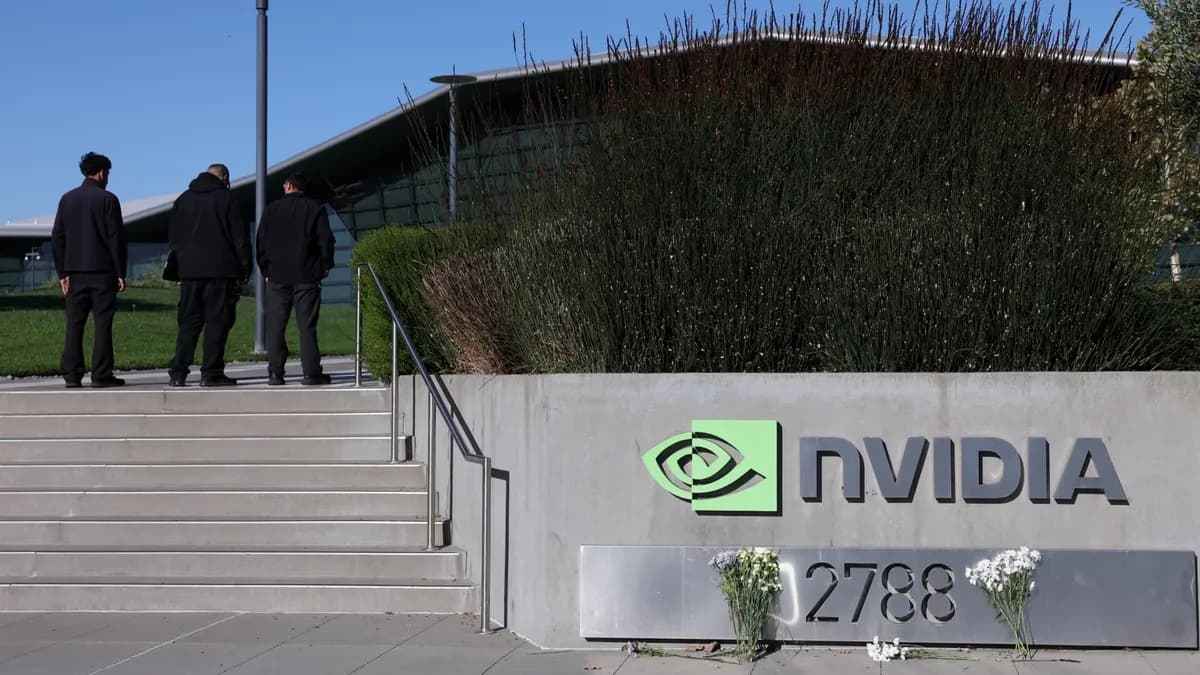
Nvidia's stock price has dropped by approximately 30% since October 6, following the sudden resignation of Jensen Huang, its founder and CEO. This drop, which has brought the stock down to around $160, is primarily due to the perceived risk created by the departure of a visionary leader without a clear succession plan. Beyond the psychological impact, this situation has created a discrepancy between the current valuation of the stock and Nvidia's underlying fundamentals, opening up opportunities for more sophisticated investment strategies, such as options trading.
Context of Jensen Huang's Resignation
Jensen Huang was considered the driving force behind Nvidia's dominance in artificial intelligence (AI). Under his leadership, the company developed a suite of high-performance graphics processing units (GPUs) and the CUDA software ecosystem that enables developers to fully harness the power of parallel computing. Additionally, Nvidia strengthened its portfolio with high-performance networking capabilities, a strategic advantage in modern data centers. Despite the departure of the leader, these structural elements—the technological superiority of GPUs, the established software base, and networking expertise—remain intact and continue to support Nvidia's competitive position in the global AI market.
The succession vacuum, however, has initiated a search process for a new CEO that could potentially take several months, according to analysts. This uncertainty is exacerbated by increased scrutiny from international regulators examining Nvidia's business practices in light of AI's growing influence. These factors collectively contribute to an exceptionally high implied volatility (IV), reminiscent of the peaks observed during the 'tariff tantrum' of Q1 2025, when trade tensions significantly disrupted markets.
Implied Volatility Analysis
The IV represents the premium that the market assigns to expectations of future stock price variations. Since Huang's resignation, Nvidia's IV has reached unprecedented levels not seen since Q1 2025, reflecting investors' fear and uncertainty about the company's future direction. This increase in IV directly translates into higher option premiums, particularly for out-of-the-money (OTM) call options. In other words, each option contract sold generates a higher premium, increasing potential revenue for investors adopting a covered call strategy.
Market data indicates that call options with a strike price of $185 expiring on December 1 are trading at premiums more than 40% higher than their historical averages. This additional premium is exclusively attributable to the risk premium that market participants integrate into option prices to compensate for succession uncertainty and potential regulatory pressures.
Detailed Functioning of a Covered Call Strategy
A covered call strategy involves simultaneously holding a long position in the underlying stock and selling an OTM call option against it. In practical terms, an investor buys 100 shares of Nvidia and, concurrently, sells an OTM call option with a strike price above the current stock price. The mechanism relies on two main components:
Option premium received: Selling the call option generates immediate premium income that boosts the overall portfolio return. This premium is directly proportional to IV; higher IV results in a higher premium.
Cap on potential gain: If the stock price exceeds the strike before expiration, the investor is obligated to sell their shares at the strike price, thereby limiting potential profit to the difference between the initial purchase price and the strike, plus the received premium.
In the current context, the premium received for the $185 call option expiring on December 1 represents an additional source of revenue that partially offsets Nvidia's stock price decline since October. For example, if the premium is $7.50 per share, this corresponds to a $750 revenue for each lot of 100 shares, yielding an annualized return of over 5% based on the $160 purchase price.
Specific Advantages of the Strategy in Nvidia's Context
Beyond the additional revenue, the covered call strategy offers several benefits tailored to Nvidia's situation:
Protection against further decline: The received premium acts as a cushion that reduces the net cost of the position. If the stock price drops further, the loss is mitigated by the already earned premium.
Controlled exposure to volatility: Selling options during periods of high IV allows investors to capture elevated premiums while limiting exposure to extreme price movements.
Capital optimization: The strategy enables generating regular revenue without deploying additional capital, which is particularly pertinent when the stock price is deemed attractive based on fundamental valuation.
It is important to note that this strategy does not eliminate the risk of capital loss. If the stock price falls below the initial purchase price, the received premium will not fully compensate for the loss. However, in a scenario where the stock price stabilizes around current levels or rebounds slightly, the additional revenue can transform a neutral position into a profitable one.
Example of the Proposed Trade
The recommended trade involves buying 100 shares of Nvidia at approximately $160, representing a total investment of $16,000. Simultaneously, the investor sells an OTM call option with a strike price of $185 expiring on December 1 for a premium of $7.50 per share. The detailed calculation is as follows:
Cost of buying shares: 100 × $160 = $16,000.
Premium received for the call option: 100 × $7.50 = $750.
Initial net cost: $16,000 - $750 = $15,250.
Maximum potential gain (if the price exceeds $185): (Strike - Purchase Price) + Premium = ($185 - $160) + $7.50 = $32.50 per share, or $3,250 in total.
Maximum potential loss (if the price drops to zero): Initial net cost = $15,250, minus the already earned premium, resulting in a loss of $15,250. However, the premium already mitigates approximately 4.7% of the potential loss.
This scenario demonstrates that the $750 premium increases the annualized return of the position, even if the stock price remains stable or rises moderately. If the stock price remains below $185 at expiration, the investor retains the shares and can potentially sell another call option, creating a recurring revenue stream as long as IV remains elevated.
Implications for Institutional and Retail Investors
Institutional investors, who often hold large volumes of Nvidia shares, can apply the same logic on a larger scale by selling options on multiple lots of 100 shares. Their portfolios would then benefit from an additional revenue source that can help offset management fees and improve the risk-return ratio. For retail investors, this strategy is accessible through brokerage platforms offering standardized option trading. However, it is crucial to maintain sufficient margin to cover the risk of having to deliver shares in case of call option exercise.
Risk Management and Practical Considerations
Several factors warrant careful consideration before implementing this strategy:
Strike selection: A strike price too close to the current price increases the likelihood of exercise, limiting potential gain. A strike price too high reduces the received premium. The $185 strike represents a reasonable compromise, offering an attractive premium while leaving room for some price appreciation.
Expiration: Short-term options (1 to 2 months) typically capture peak volatility. The December 1 expiration coincides with the period when succession-related uncertainties are expected to remain high.
Implied volatility monitoring: If IV begins to decrease significantly, future premiums will be lower. In such cases, it may be prudent to close the position or adjust the strike.
Portfolio management: Selling calls should not compromise the ability to profit from a potential stock price rebound. It is recommended to cover only a portion of the portfolio to maintain some residual exposure to upside.
Additionally, tax implications for options should be considered. In many jurisdictions, option premiums are taxed as ordinary income, while capital gains from stock sales are taxed separately. Appropriate tax planning can enhance the net return of this strategy.
Medium-Term Outlook for Nvidia
While Jensen Huang's departure creates short-term uncertainty, Nvidia's fundamentals remain strong. Global demand for AI-powered GPUs continues to grow, supported by sectors such as data centers, gaming, and autonomous vehicles. Nvidia's business model, based on high-end hardware sales and software licensing, generates high margins that provide some resilience against stock price fluctuations.
Over the next six to twelve months, several scenarios are possible: a swift appointment of a new CEO could reassure the market and reduce IV, limiting the appeal of covered call strategies. Conversely, if the transition proves longer or regulatory hurdles arise, IV may remain elevated, maintaining the profitability of covered call strategies. In either case, this strategy remains a flexible tool for adjusting risk-return profiles according to evolving market conditions.
Operational Summary of the Trade
The proposed trade can be summarized in three key steps:
Purchase 100 shares of Nvidia at approximately $160, reflecting the current price level after the 30% drop since October 6.
Sell an OTM call option with a strike price of $185 expiring on December 1 for a premium of approximately $7.50 per share, generating immediate revenue of $750.
Monitor implied volatility and stock price movements, with the option to sell another call option at each expiration as long as IV remains elevated, transforming the position into a recurring revenue stream.
This approach exploits the market dynamics induced by Nvidia's succession uncertainty while offering partial protection against further stock price declines. It aligns with an investment philosophy that prioritizes purchasing high-quality companies at reduced prices and optimizing capital allocation through derivative instruments.