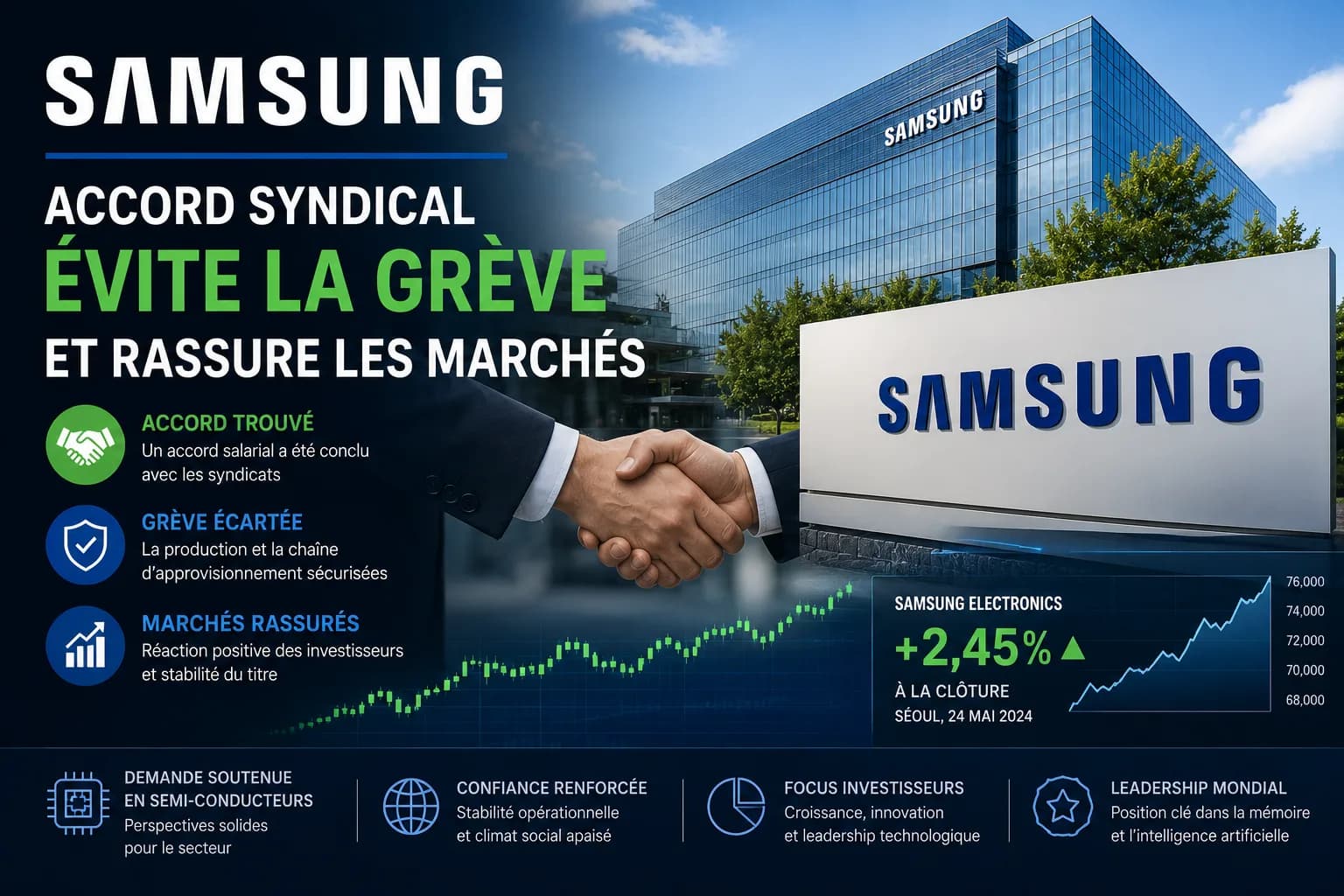
Samsung: Union agreement averts strike and reassures markets
Samsung Electronics has reached a provisional agreement with its union, dispelling the specter of a major strike. This positive outcome relieves global markets, particularly those linked to semiconductors, and could have repercussions on individual investment strategies.
The threat of a strike at Samsung Electronics, the South Korean giant and global leader in memory chips, has dissipated. A provisional agreement has been reached between management and the union, news that immediately boosted the South Korean stock market and sent positive ripples through international financial markets. The stakes were high: a production interruption at Samsung would have had considerable consequences on an already strained industry, impacting the availability and prices of essential components for all global electronics.
Tension eases in the semiconductor market
The announcement of this agreement, reported by Bloomberg, comes after tense negotiations. The union, representing a significant portion of Samsung Electronics employees, had put forward demands concerning wages and working conditions. The prospect of a strike had raised fears of a major disruption in the semiconductor supply chain, a sector already weakened by geopolitical tensions and demand fluctuations. Samsung, a key player in DRAM and NAND memory, is an essential link in the technological ecosystem. A cessation of its production activities would have led to a rise in prices and delivery times for many manufacturers of computers, smartphones, and servers worldwide. Samsung's ability to overcome this internal social crisis without production stoppages is therefore excellent news for market stability.
The provisional agreement ends a period of uncertainty that weighed on Samsung's stock price and, by extension, on all companies in the sector. Investors feared a "domino effect" where a shortage of Samsung components would affect the production of other tech giants, such as Apple or Qualcomm. The rapid resolution of this social conflict helps reassure supply chains and maintain a stable production flow, essential in a context of continuous technological innovation and sustained demand for cutting-edge electronic products. This positive outcome underscores the importance of social relations in the sustainability of large industrial companies and their impact on the global economy.
Why does this agreement have such an impact?
The main reason for the positive shockwave on the markets lies in Samsung Electronics' dominant position. The group is the world's leading producer of memory chips, fundamental components for all modern electronic devices. A strike would have caused an almost immediate shortage, sending prices soaring and affecting the entire technology industry. Financial analysts from Bloomberg and the Wall Street Journal had indeed warned about the risks of such a disruption. The agreement averts this potential crisis, allowing manufacturers to maintain their production schedules and meet the demand from consumers and businesses. Furthermore, it helps stabilize semiconductor prices, which have experienced significant volatility in recent years.
Beyond the purely industrial aspect, this agreement has a strategic dimension. It demonstrates Samsung's ability to manage its internal relations and maintain operational continuity, a key factor for investor confidence. In a sector as competitive and capital-intensive as semiconductors, where investments run into billions and development cycles are long, operational stability is paramount. The peaceful resolution of the social conflict strengthens Samsung's image as a reliable partner and a stable player on the global stage, thus reassuring markets about its ability to innovate and produce on a large scale.
Impact for the French investor
For the French investor, this news is generally positive, although the direct impact on a diversified portfolio may seem limited. Samsung Electronics is a company listed in South Korea, whose shares are accessible through trading platforms, but it is not directly eligible for the PEA (Plan d'Épargne en Actions) or French life insurance in most contracts. However, repercussions on global markets can indirectly affect portfolios.
On the stock market: If you hold shares in technology companies that depend on semiconductors (smartphone manufacturers, PC manufacturers, or even competing or partner semiconductor companies), this news is reassuring. It avoids downward pressure on their margins due to rising component costs. For those investing in World ETFs or thematic technology ETFs, the risk of underperformance related to a crisis at Samsung is averted. Samsung shares (005930.KS on the Korean stock exchange) could see a slight appreciation following this news, but direct access remains less common for French individuals compared to European or American stocks.
Investment strategies: The agreement at Samsung reinforces the potential upward trend in the global technology sector, particularly semiconductors. Investors can consider:
Technology ETFs: ETFs such as Lyxor Nasdaq 100 (LU1681043570) or Xtrackers MSCI World Information Technology (LU0292108341) could benefit from this increased sector stability. Eligibility for the PEA for certain technology ETFs is a point to verify.
Equipment manufacturer stocks: Companies like ASML (ASML), which manufactures the machines needed for chip production, could see their business normalize more quickly thanks to the resumption of production at their clients like Samsung.
Diversification: For the French investor, it remains crucial not to over-weight a single sector. This event highlights the importance of diversification, including geographical diversification, to mitigate risks specific to a company or a national market. MSCI World ETFs remain a safe bet for broad and diversified exposure.
In summary, although Samsung is not a stock directly accessible through the most common French tax-advantaged accounts, the resolution of this social conflict is a signal of stability for the global technology sector. Investors paying attention to sector trends and the health of global supply chains can see it as an opportunity to confirm their positions in technology ETFs or stocks of companies linked to this ecosystem.
Outlook and vigilance
This provisional agreement is a crucial first step, but vigilance remains necessary. The details of the final agreement will be closely scrutinized by the markets and employees. Samsung's history of labor relations shows that tensions can resurface if commitments are not met. Nevertheless, the signing of an agreement, even a provisional one, demonstrates a willingness to dialogue and compromise, which is a strong signal of maturity from the company and its union representatives. The absence of a major strike allows Samsung to focus on its production and innovation goals, particularly in growth areas like artificial intelligence and advanced chips.
The positive reaction of stock markets, particularly in South Korea, reflects general relief. Financial analysts, such as those at the Financial Times, emphasize that resolving this conflict strengthens confidence in Samsung's ability to maintain its leadership in the semiconductor market. In the longer term, the company's ability to innovate and adapt to new technologies will be decisive for its success and the performance of its shares. For the investor, this news allows for a more serene outlook on the global technology sector, while awaiting new economic and strategic data.