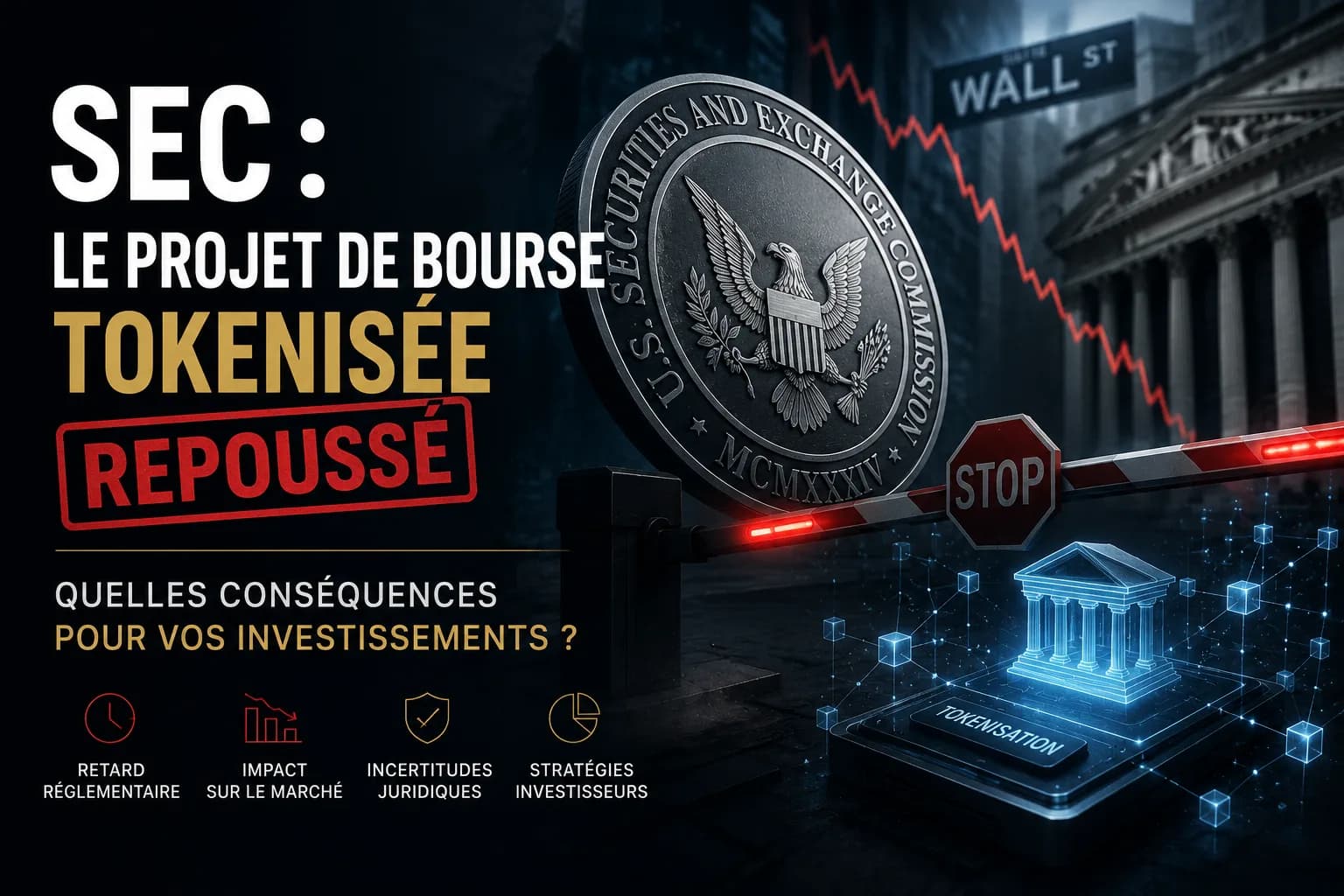
SEC: Tokenized Stock Project Postponed, What Are the Consequences for Your Investments?
The US SEC postpones its decision on the trading of tokenized stocks, sowing uncertainty in the markets. Discover the potential impact of this decision on your investments and how to adapt your strategy.
The financial markets landscape is constantly evolving, and innovations like asset tokenization generate both enthusiasm and caution. Recently, the U.S. Securities and Exchange Commission (SEC) announced a postponement of its decision regarding a plan to authorize the trading of tokenized stocks. This news had an immediate ripple effect on cryptocurrency markets, leading to a particularly difficult day for assets such as Bitcoin (BTC), Ethereum (ETH), and SUI, which experienced significant drops. Far from being a mere regulatory hiccup, this decision raises fundamental questions about the future of decentralized finance and its integration with traditional markets.
A Regulatory Setback for Tokenized Finance
The SEC has officially postponed its review of the plan that would have paved the way for trading stocks in the form of digital tokens. This regulatory waiting period, while not necessarily a definitive rejection, creates a climate of uncertainty. Tokenized stocks represent a potential fusion between the world of blockchain and that of traditional stock markets. The idea is to be able to fractionalize stocks, make them more accessible, more liquid, and potentially tradable 24/7. Such a system could revolutionize how investors access and trade assets, by eliminating certain intermediaries and reducing settlement times.
However, the nature of these assets raises considerable regulatory challenges. The SEC, as the watchdog of American financial markets, must ensure that these new instruments comply with existing securities laws, protect investors, and maintain market integrity. The postponed decision suggests that the SEC's concerns are far from resolved. It is likely that issues related to token classification (are they securities?), the security of trading platforms, the prevention of market manipulation, and the protection of investor data are at the heart of the discussions.
This regulatory slowdown can be interpreted in several ways. On the one hand, it reflects the complexity of integrating innovative financial technologies into a legal framework established for decades. On the other hand, it may reflect the SEC's desire to observe market evolution and adopt a more measured approach before giving the green light to potentially disruptive innovations. The regulatory authority is likely seeking to avoid setting a precedent that could have unforeseen consequences on the entire financial system.
The immediate reaction of cryptocurrency markets to this news was marked by a sharp decline. Bitcoin, the first and largest cryptocurrency, saw its price fall, dragging Ethereum and other altcoins like SUI in its wake. This correlation is not new. Cryptocurrency markets are often sensitive to regulatory news, especially from major authorities like the SEC. Uncertainty about the future of tokenized stocks can be perceived as a negative signal for the entire digital asset ecosystem.
Several reasons explain this chain reaction. Firstly, the failure or delay in approving such a project can be interpreted as a lack of support or a reluctance from regulators to fully embrace tokenization. Yet, institutional adoption and the legitimacy of cryptocurrencies often depend on easier integration with traditional markets. Secondly, some players in the cryptocurrency market are directly interested in the development of stock tokenization. Platforms that offer or plan to offer these instruments see their prospects called into question. Thirdly, an uncertain regulatory environment can deter investors, including investment funds and large institutions, from deploying capital into assets deemed potentially risky or with an uncertain future.
The drops observed in BTC, ETH, and SUI are therefore not just a reflection of an emotional reaction, but also a logical consequence of increased anticipation and perceived risks by investors. The inherent volatility of cryptocurrency markets amplifies these movements. When negative news arises, profit-taking can accelerate, leading to sharper drops than in more mature markets. It is essential to remember that regulatory news is a key factor influencing cryptocurrency price dynamics.
Impact for the French Investor: How to Navigate Uncertainty?
For the French investor, this SEC decision, although American, has significant indirect implications. The global financial ecosystem is increasingly interconnected. Regulatory developments in the United States can influence how European regulators, such as the Autorité des Marchés Financiers (AMF) in France, approach similar issues. Uncertainty surrounding stock tokenization could slow the emergence of similar products in Europe or make their regulatory framework stricter.
In this context, several strategies are available to you:
Prudent Diversification: Do not put all your eggs in one basket. If you invest in cryptocurrencies, ensure that they represent only a small portion of your overall portfolio. Favor more traditional assets for the core of your savings, such as ETFs replicating the S&P 500 or the MSCI World, accessible through a Plan d'Épargne en Actions (PEA) or a regular securities account (CTO). These products are less sensitive to the regulatory uncertainties of a niche market.
Monitoring European Regulations: Stay informed about regulatory developments in Europe concerning tokenization and digital assets. The European Union, with its MiCA (Markets in Crypto-Assets) regulation, has already laid the groundwork for regulating cryptocurrencies. Any evolution concerning tokenized stocks in Europe could have a direct impact on products available to French investors.
Focus on Existing Tokenized Assets: If you are particularly interested in blockchain technology and tokenization, focus on projects and platforms that already have a certain maturity and a clearer legal framework, or that are already listed on traditional markets (even if they are not tokenized stocks in the strict sense). For example, some publicly traded tech giants, such as those found in the S&P 500 ETF, are heavily involved in developing technologies that could eventually support tokenization.
Choice of Investment Platforms: Opt for reputable and regulated brokers and investment platforms in France or the European Union, such as Trade Republic or Degiro (which has a branch in France). These platforms offer a wide range of products and compliance with local regulations, thus providing you with greater protection against international regulatory uncertainties.
Understand Taxation: Do not forget that cryptocurrencies and tokenized stocks (if they become available and are considered securities) have specific tax regimes in France. It is crucial to fully understand the capital gains tax for digital assets and traditional stocks to optimize your tax return. The capital gains tax on cryptocurrencies, for example, is distinct from that on stocks.
In short, investing in potentially disruptive assets like tokenized stocks requires increased vigilance. The current regulatory uncertainty reinforces the need for a thoughtful investment approach, focused on diversification, continuous information, and understanding the specific risks of each asset class. The SEC's lack of decision does not mean the end of tokenization, but rather a phase of adjustment and clarification that could take time.
Outlook: A Long and Complex Road for Tokenization
The postponement of the SEC's decision on tokenized stocks is just one chapter in the long story of integrating blockchain technologies into traditional finance. The debate over the tokenization of financial assets, including stocks, is likely to continue for some time. Regulators will need to strike a balance between encouraging innovation and protecting investors and financial stability. The blockchain industry, for its part, will continue to develop solutions to address regulatory concerns.
The future may see the emergence of clearer regulatory frameworks, potentially allowing the trading of tokenized stocks on regulated platforms. This could happen gradually, perhaps initially through derivatives or tokenized funds, before reaching directly tokenized stocks. For the investor, this means remaining patient and informed. Opportunities will exist, but they will require in-depth analysis of the associated risks and regulatory frameworks. The current volatility of cryptocurrencies, amplified by this news, underscores the importance of a solid and diversified investment strategy, anchored in the long term, rather than reacting impulsively to market fluctuations.
Legal Disclaimer: This article is for informational purposes only and does not constitute investment advice. Investments in cryptocurrencies and financial assets carry the risk of capital loss. It is recommended to consult a professional financial advisor before making any investment decisions.