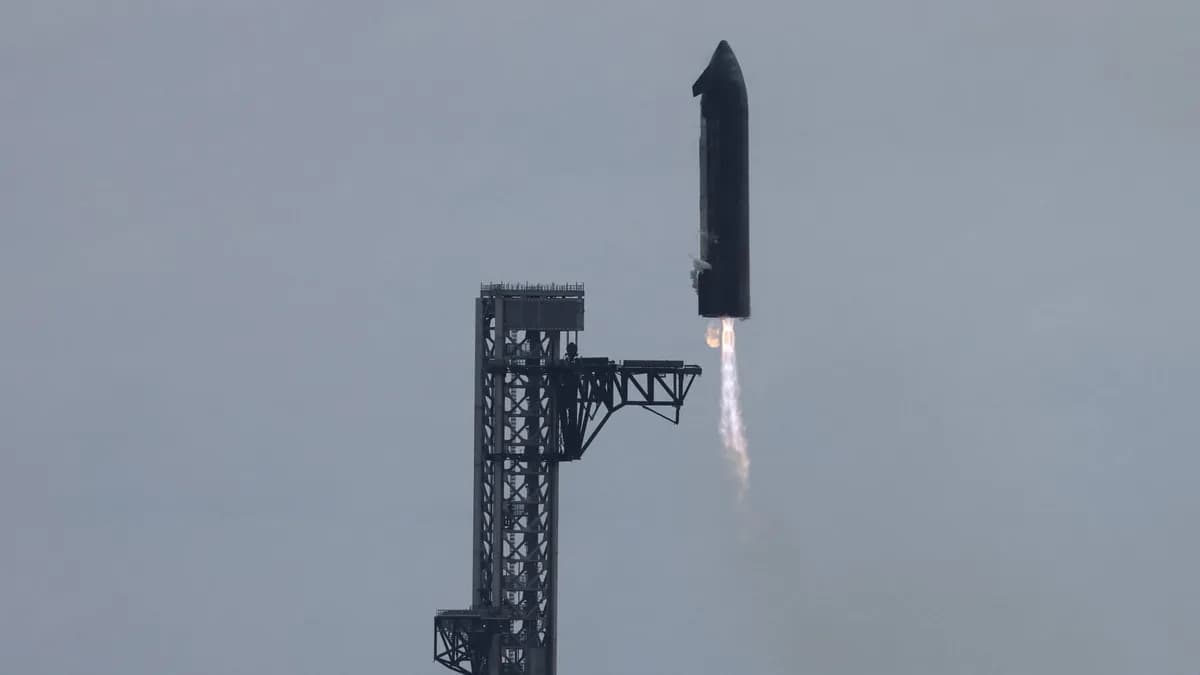
SpaceX Achieves Historic Milestone: Recovery of its Spacecraft in Orbit
SpaceX successfully recovered its spacecraft in orbit during a launch over the weekend, marking an important step in aerospace history and exciting financial analysts.
Orbital Recovery, a Historic Achievement for SpaceX
Over the weekend, SpaceX took a decisive step by recovering its spacecraft in orbit during the Starship flight 15, launched from Starbase, Texas. This operation, which took place on November 13 and 14, 2026, involved capturing the upper stage of the vehicle with mechanical arms, dubbed "Mechazilla", similar to long and articulated chopsticks, installed on the launch tower. Unlike previous attempts where upper stages were lost or severely damaged during atmospheric re-entry, the capture mechanism allowed for the recovery of the vehicle in near-intact condition, demonstrating the viability of a fully reusable system.
This technical success addresses a recurring problem in the space industry: the loss of economic value due to damage sustained by rockets during re-entry. Historically, launchers could only be partially recovered, increasing the average cost of a launch by several tens of percent. By capturing the upper stage directly from orbit, SpaceX eliminates the phase of thermal and mechanical re-entry, thus reducing refurbishment costs. According to analysts at Citi, this progress opens the door to a substantial reduction in the price per kilogram launched, a key factor in making commercial, scientific, and even tourist missions more accessible.
The Mechazilla mechanism relies on precision sensors, rapid-response actuators, and real-time control software capable of compensating for residual orbital movements. The arm positioned itself within two meters of the spacecraft, engaged the hooks, and stabilized the object before slowly lowering it onto the landing platform. This choreography, observed live by a crowd of stakeholders, confirms SpaceX's ability to orchestrate complex operations in the vacuum of space, an achievement previously considered science fiction.
Analysts Praise SpaceX's Performance
The financial implications of this success were quickly reflected in Wall Street analysts' evaluations. John Godyn, senior analyst at Citigroup, published a note on Monday following the event, highlighting that flight 15 and the Starship capture constitute "one of the key milestones we had identified on a multi-year path towards a valuation over $900". Consequently, Citi raised its price target for SpaceX shares from $240 to $280, estimating that the stock was already trading near double Friday's previous close.
Meanwhile, Morgan Stanley maintained an "Overweight" recommendation with a price target of $300, arguing that the spacecraft capture "materially de-risks the long-term TAM (Total Addressable Market) for the three segments of the business". The firm notes that estimates beyond 2028 are heavily dependent on Starship's ability to be rapidly and frequently reused, particularly for orbital compute projects and lunar missions requiring frequent, low-cost launches.
Goldman Sachs issued a "Buy" recommendation with a price target of $245, noting that flight 15 positively evaluated SpaceX's operational performance. The Goldman report, although partially truncated, emphasizes that the ability to capture the upper stage reinforces confidence in the company's value chain, from Raptor engine manufacturing to recovery and refurbishment logistics.
All these evaluations converge on one point: full reuse of both stages of Starship represents an exponential value creation lever. By reducing launch costs proportionally with the frequency of reuse, SpaceX could see its revenue increase by tens of billions of dollars, particularly through satellite constellation launch services for governments and private actors seeking to exploit space.
SpaceX's Prospects
The spacecraft capture opens the door to a new era of low-cost space missions. SpaceX's business model now rests on three interdependent pillars: the Starlink satellite constellation, orbital transport services (including lunar and Martian missions), and the emerging "Super Intelligence" segment, which combines orbital computing capabilities and high-speed data services. Full Starship reuse could reduce launch costs by more than 70% according to internal estimates, making large-scale missions financially viable for clients previously limited by budget.
Politically, SpaceX's success comes at a time when American and European governments are strengthening their space programs. NASA and ESA budgets for lunar missions and commercial space station projects have increased by 12% in 2026, creating additional demand for reliable, low-cost launchers. SpaceX's ability to offer rapid, reusable launches positions it as the preferred partner for Artemis programs and future Mars sample return missions.
Moreover, the market for low Earth orbit (LEO) satellites continues to grow rapidly, with a projection of over 10,000 satellites by 2030, a 250% increase from 2024. The reduction in launch costs through Starship reuse could accelerate Starlink constellation deployment, aiming to cover 90% of the global population by 2035. Each additional economically viable launch generates recurring revenues through internet subscriptions, creating a significant financial leverage effect.
Lastly, the "Super Intelligence" segment referenced by Citi pertains to distributed computing capabilities in orbit, where recovered upper stage modules can be reused to offer high-performance computing services to industrial clients. This market, estimated at over $5 billion by 2028, relies on the ability to rapidly recover and refurbish modules, a process now demonstrated by flight 15.
Impact on Investors
For shareholders, the spacecraft recovery represents a strong signal of reduced operational risk and increased long-term growth potential. The increase in Citi's price target to $280, combined with Morgan Stanley's $300 and Goldman Sachs' $245 targets, creates a valuation range that places the stock above its current market level, suggesting a 15-25% premium for investors entering now.
However, it is crucial to keep in mind that the space sector remains highly dynamic. Competition is intensifying with actors like Blue Origin developing its New Glenn launcher and Amazon advancing its Kuiper project, both also targeting reusability, which could put downward pressure on launch prices if multiple companies achieve similar performances.
Investors should therefore monitor key indicators such as the number of successful Starship flights with full recovery, upper stage refurbishment rate, monthly launch cadence, and government and satellite operator contracts. SpaceX's ability to maintain a rhythm of 12-15 fully reusable launches per month would be a major catalyst for valuations, while any delay or technical failure could lead to downward revisions.
In summary, the success of flight 15 confirms the technical feasibility of full Starship reuse, strengthens SpaceX's economic growth prospects, and justifies analysts' upward revisions of price targets. Astute investors can thus benefit from exposure to a company redefining space costs and business models while remaining vigilant to competition and inherent technical risks in space exploration.