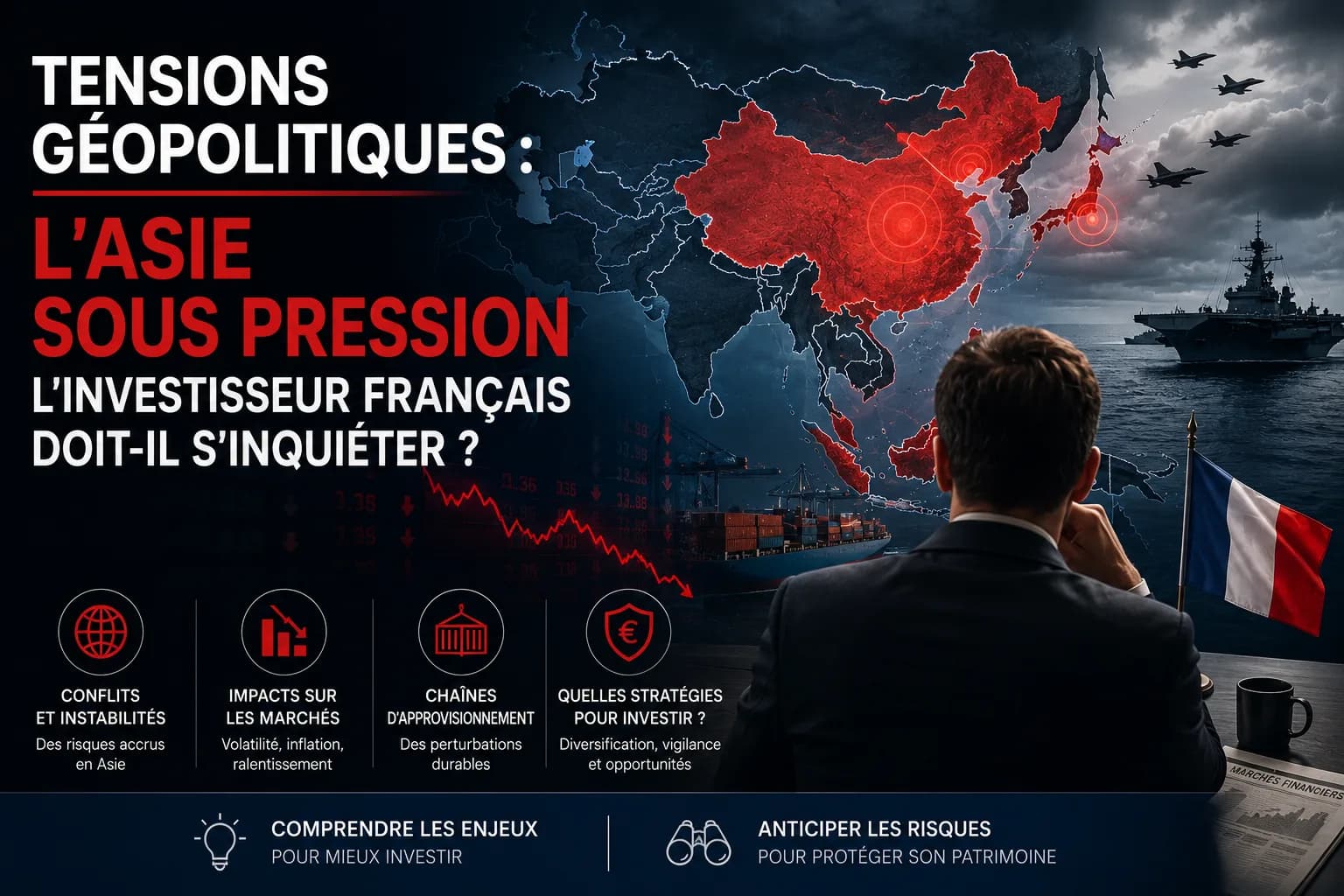
Geopolitical Tensions: Asia Under Pressure, Should French Investors Be Worried?
The conflict in Iran is causing increased instability in Asian markets, driving up bond yields and depreciating certain currencies. What are the consequences for your portfolio?
Recent geopolitical escalations related to Iran are shaking global financial markets, with a particularly marked impact on Asian emerging economies. According to Bloomberg Markets analysis, the current situation is pushing currencies and bonds in several countries in the region towards extreme levels, once deemed improbable. This increased turbulence raises legitimate questions about its scope and implications for international investors, including those based in France.
The War in Iran: A New Risk Factor for Asia
The worsening tensions in the Middle East, exacerbated by recent events involving Iran, are acting as a risk catalyst for emerging markets, particularly those in the Asian continent. This region, often perceived as a global growth engine, suddenly finds itself facing extreme bearish scenarios. Asian currencies, already under pressure due to tighter US monetary policy and a global economic slowdown, are now bearing the brunt of concerns related to a major regional conflict. Bond yields in several Asian countries have soared, reflecting an increased risk premium demanded by investors to hold these assets. This surge in yields makes financing more expensive for governments and companies in the region, potentially hindering their investment and development projects.
Asian bond markets are particularly sensitive to these external shocks. Rising yields on Asian sovereign and corporate bonds can lead to significant capital outflows, as investors seek refuge in assets deemed safer, such as US Treasury bonds or gold. This capital flight can exert downward pressure on local currencies, making imports more expensive and fueling inflation. For economies heavily reliant on imports of essential goods or raw materials, like many Asian countries, currency depreciation can have considerable economic and social consequences. The extreme scenarios envisioned by Bloomberg include larger-than-expected currency depreciations and forced interest rate hikes to try and stabilize markets, at the risk of stifling economic growth.
Why These Movements Are Crucial for Global Markets
Asia, as a nerve center for global production and a rapidly expanding consumer market, plays a decisive role in overall economic stability. A destabilization of its financial markets therefore has repercussions that extend far beyond its borders. International investors, who have massively allocated capital to this region in recent years, are directly exposed to the risk of losses. The growing correlation between global financial markets means that a major shock in Asia can quickly spread to other regions, including Europe and North America. Multinational corporations with a significant presence in Asia may see their profits impacted by currency volatility and a slowdown in local demand. Furthermore, geopolitical tensions in the Middle East have a direct impact on energy prices, a crucial component of the global economy. A surge in oil prices, for example, can increase production and transportation costs worldwide, fueling inflation and weighing on consumption.
Central banks, whether it's the US Federal Reserve (Fed) or the European Central Bank (ECB), are closely monitoring these developments. Prolonged instability in Asian markets could influence their monetary policy decisions. If inflation were to accelerate globally due to supply chain disruptions and rising energy prices, central banks might be forced to maintain higher interest rates for longer, or even implement further hikes. This would increase the cost of credit globally and could further curb economic activity. Conversely, if the situation were to deteriorate to the point of threatening global growth, central banks might reconsider their approach, thus creating a new source of uncertainty for the markets.
Impact for French Investors: Anticipate and Protect Your Portfolio
For French investors, the current situation in Asian markets, amplified by the Iranian geopolitical risk, calls for increased vigilance and a potential strategic portfolio reallocation. Direct investments in Asian stocks or bonds can prove risky in this volatile context. If you hold ETFs exposed to Asian emerging markets through your PEA or your CTO, it is crucial to assess their composition. Some ETFs may be overweight in stocks from countries more sensitive to geopolitical shocks or currency volatility. Prudent diversification remains key: favor broad ETFs like the MSCI World ETF which offer global exposure and dilute geographical risk. For those who wish to maintain exposure to emerging markets, using more diversified ETFs or those focused on regions less directly affected by the conflict could be considered.
Regarding French or European stocks, the impact will be more indirect but real. CAC 40 companies, such as LVMH or TotalEnergies, have significant international exposure. While some, like TotalEnergies, could benefit from rising energy prices, others whose business depends on Asian markets or global supply chains could suffer from a slowdown. Life insurance, often used for diversification, can offer relative protection through its less volatile euro funds, but units of account exposed to international stock markets must be scrutinized. It is advisable to check the geographical and sectorial allocation of your units of account and consider reducing exposure to the riskiest areas if your risk profile allows. Using tools like a DCA simulator can help smooth the impact of volatility on your regular investments.
Managing Currency Risk and Volatility
The depreciation of Asian currencies against the euro is a major risk for French investors holding assets denominated in these currencies. If you have invested directly in Asian stocks or non-currency-hedged funds, the loss in value of the local currency is added to a potential drop in the stock price, amplifying losses in euros. It is therefore relevant to favor, where possible through ETFs, funds whose currency is hedged into euros, although this may incur additional fees and sometimes slight underperformance during periods of growth. For active investors, a cautious approach could involve temporarily reducing positions in the most fragile currencies or turning to assets considered safe havens, such as gold, whose performance may be less correlated with traditional stock markets.
Increased market volatility also implies a reassessment of your risk tolerance. The extreme scenarios described by Bloomberg suggest that significant price movements, both up and down, are to be anticipated. It is therefore crucial not to panic in the face of fluctuations and to stick to your long-term investment strategy. However, this does not mean ignoring the risks. A periodic review of your asset allocation is recommended, potentially reducing exposure to the riskiest assets and increasing the proportion of more defensive assets, especially if your investment horizon is approaching. Diversification remains your best ally to navigate these periods of uncertainty.
Outlook: Between Geopolitical Risks and Economic Resilience
The evolution of the geopolitical situation in the Middle East is the main driver of short-term uncertainty for Asian and global markets. Any new escalation could trigger a negative chain reaction, pushing currencies and bonds towards the feared extreme levels. Energy prices remain a key barometer of this risk. However, it is important to note that Asian economies have shown some resilience to external shocks in the past. Monetary and fiscal policies implemented by local governments and central banks will play a crucial role in mitigating these pressures.
In the longer term, the trajectory of Asian markets will depend on structural factors such as demographic growth, technological innovation, and regional integration. If the current geopolitical risks are managed without escalating into a major and prolonged regional conflict, Asia could regain its growth potential. For French investors, this means that selective and diversified exposure to Asian markets could remain relevant in the long term, provided currency and volatility risks are well managed. Analysis of Bloomberg Markets data suggests that extreme scenarios are possible, but not inevitable, highlighting the importance of a cautious and well-informed investment strategy.
Legal Disclaimer: This article is provided for informational purposes only and does not constitute investment advice. Past performance is not indicative of future results. All investments involve the risk of capital loss. It is recommended to consult a financial professional before making any investment decisions.