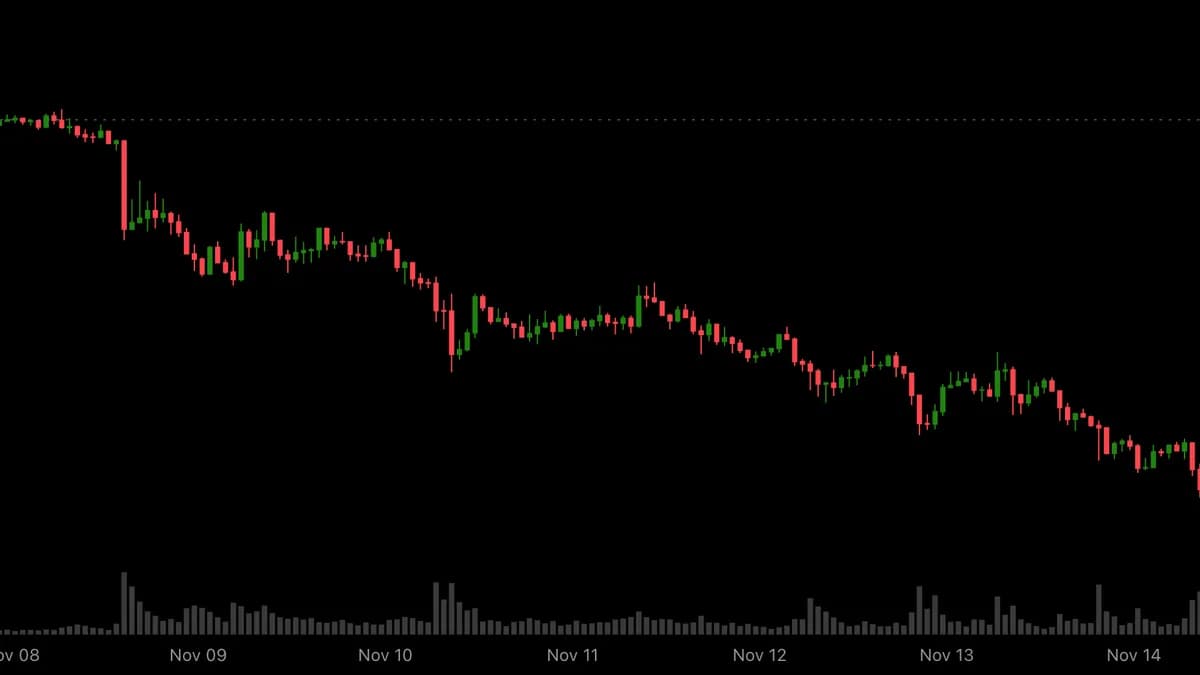
XRP falls to $0.89 – its lowest since November 2024, under pressure from ETF outflows
The XRP token hit $0.89, its lowest level since November 2024, after a 36% decline this quarter. Net outflows of $19.13M from XRP ETFs and the rapid contraction of USDT/USDC stablecoins intensified the sell-off.
On November 14, 2026, XRP's price touched $0.89, its lowest point since November 2024. The crypto asset lost 36% over the quarter, continuing a decline that began in July 2025, when it was trading above $3.60. This drop occurred in a broader context where Bitcoin and Ether also slipped, reaching levels seen for the first time since August.
XRP Hits $0.89 – Its Lowest Since November 2024
The immediate trigger for the drop stems from significant investment outflows from listed funds (ETFs) dedicated to XRP. According to SoSoValue data, U.S.-listed ETFs recorded a net outflow of $19.13 million last week, the largest since March 2026. This outflow pressure exacerbated the decline in liquidity available for the token, making each sale more impactful on the price.
Since their launch in November 2025, XRP ETFs have accumulated approximately $1.5 billion in assets under management, an amount significantly lower than the several billion attracted by Bitcoin and Ether ETFs. This size difference means that capital movements affect XRP's price proportionally more, amplifying the observed volatility.
Massive XRP ETF Outflows Fuel the Decline
Meanwhile, the stablecoin market, the primary vehicle for financing crypto purchases, shows signs of contraction. The combined market capitalization of USDT and USDC fell to $244 billion, its lowest level since September 2025, after peaking at $270 billion in early May.
Glassnode highlighted that stablecoin supply decreased by $17 billion over the past month, the steepest drop since 2022. "Stablecoin supply is shrinking fast. It fell by $17B over the last month, the steepest drop since 2022. As holders swap stables to fiat they drain buying power from BTC and crypto," the analysis states, translated into French: "L'offre de stablecoins se contracte rapidement. Elle a baissé de 17 milliards de dollars le mois dernier, la plus forte chute depuis 2022. En convertissant leurs stablecoins en fiat, les détenteurs privent Bitcoin et le reste du marché crypto de pouvoir d'achat." This liquidity reduction reinforces the downward pressure on XRP.
Stablecoin Market Contraction Reduces Capital Flows
Analysts see in this dual dynamic – ETF outflows and stablecoin withdrawals – a scenario where financing long positions becomes increasingly costly. Without stablecoin support to quickly convert funds into crypto, investors are less inclined to enter the market, further fueling the downtrend.
The link between ETF flows and stablecoin availability creates a vicious cycle: each ETF outflow reduces demand for stablecoins to finance purchases, while stablecoin contraction reduces market participants' ability to support prices, worsening ETF outflows. CoinDesk data shows this interaction has already led to a simultaneous drop in Bitcoin, which breached the $63,000 threshold for a three-month low.
Technical Analysis: Key Levels and Short-Term Scenarios
From a technical standpoint, the break of the $0.90 support signals a persistent downtrend as long as ETF outflows remain elevated. Glassnode analysts warn that, without a reversal in flows, the price could remain trapped below this level, making any recovery difficult.
Any potential rebound will depend primarily on a reversal of money flows into XRP ETFs and a stabilization of stablecoin supply. If investors regain confidence and inflows resume, the token could stabilize around its current level, but no significant upside is expected as long as structural pressures persist.
Impact on the Broader Crypto Market
XRP's decline is part of a broader move where Bitcoin fell below $63,000, its lowest in three months, and Ether also recorded notable declines. ETF outflows affect not only XRP but also Bitcoin and Ether funds, which experienced similar outflows during the same period.
For investors tracking markets via trading platforms, the convergence of these factors underscores the importance of monitoring ETF flows and on-chain indicators to anticipate the next price movements across the crypto sector.