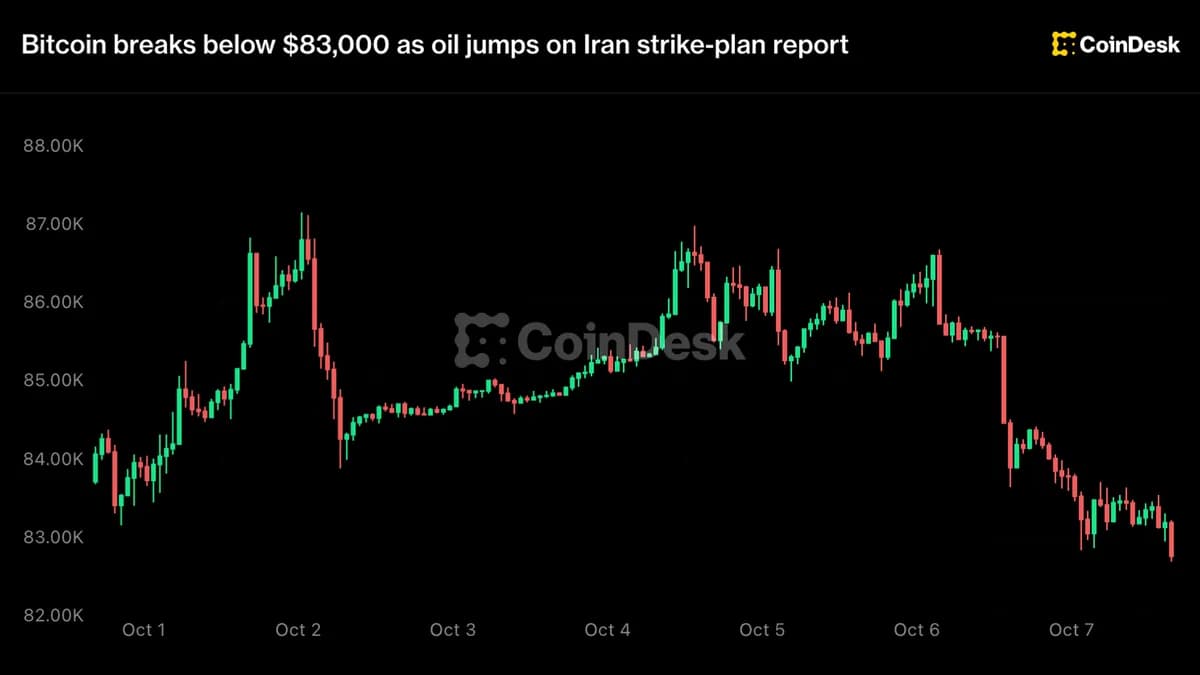
Bitcoin Plummets Below $83K Amid Oil Surge Following Potential U.S. Strike on Iran
Bitcoin dropped 1.6% below $82,800, breaching the $83,000 psychological threshold as Brent crude surpassed $102 per barrel following reports of a potential U.S. strike on Iran. The oil rally triggered a surge in Treasury yields and the liquidation of $550 million in leveraged positions.
Bitcoin closed Thursday at $82,800, down 1.6% and breaking below the psychologically significant $83,000 level. This decline came as Brent crude surged 2% above $102 per barrel, driving up Treasury yields, with the 10-year note hitting 5.31% (+2 basis points). CoinDesk reported the move stemmed from a U.S. government request to the Pentagon to explore options for striking Iran, fueling concerns about oil supply disruptions. Meanwhile, approximately $550 million in leveraged crypto positions were liquidated, mostly long positions, according to CoinGlass data. The geopolitical context created simultaneous pressure on cryptocurrencies, commodities, and bond markets.
The $83,000 level was seen as a key psychological support by many analysts, and its breach immediately triggered sell-side algorithms. FxPro, cited by CoinDesk, indicated that breaking this threshold could open "a quick path to $80,000," reinforcing the idea of accelerating bearish momentum. Bitcoin, which had been trading around $84,500 the day before, dropped 1.6% in less than 24 hours, a move fitting within a bullish trend interrupted by external factors. This increased volatility echoes previous episodes where Bitcoin prices strongly reacted to macroeconomic shocks, though no additional historical data is provided in the report.
Additionally, Bitcoin's decline caused a contagion effect across major cryptocurrencies. XRP fell nearly 4% to $1.42, while Dogecoin dropped 3% to just under $0.09. Ethereum slid 3% to approximately $2,570, and tokens like HYPE and SOL each lost over 2%. Only BNB and TRX showed slight gains, each under 1%, according to CoinDesk data. This correlation between Bitcoin and other digital assets highlights the market's sensitivity to geopolitical shocks.
Oil Price Spike and Geopolitical Tensions as Triggers
Brent crude surpassed $102 per barrel, driven not only by reports of potential U.S. strikes on Iran but also by a storm that temporarily halted U.S. oil production and a Houthis' attack on two Saudi airports, leaving three dead. This combination of events fueled perceptions of constrained supply, pushing oil prices to their highest levels since 2002. The link between oil and cryptocurrencies manifested in a flight to safety assets, particularly government bonds, at the expense of riskier assets like Bitcoin.
The oil price rally also directly impacted bond yields. The yield on the 10-year U.S. Treasury note climbed two basis points to reach 5.31%, its highest level in decades. This rise bolstered demand for fixed-income assets, increasing downward pressure on cryptocurrencies, which are often viewed as non-income generating assets. CoinDesk's report highlights that the simultaneous movement of oil prices, yields, and Bitcoin constitutes a rare configuration where all three markets reacted in the same direction.
Mass Liquidations and On-Chain Dynamics
CoinGlass data reveals that nearly $550 million in leveraged positions were liquidated, mostly long bets on Bitcoin and other cryptocurrencies. This wave of liquidations amplified selling pressure as forced traders closed their positions, adding to sell orders. The phenomenon also led to reduced margin availability on trading platforms, limiting short-term position-taking capacity.
On the on-chain front, outflows of Bitcoin to cold wallets slightly increased, signaling that some investors are seeking to secure their assets amid geopolitical uncertainty. While CoinDesk doesn't provide exact figures on on-chain volumes, the correlation between mass liquidations and wallet movements suggests growing risk aversion among holders. This dynamic is reinforced by the fact that major altcoins also registered declines, indicating that selling pressure spread beyond Bitcoin.
Key Technical Levels and Downside Scenarios
FxPro analysts identified $83,000 as a pivotal level; breaking below it opens the next major support around $80,000, which, according to their models, could be reached "fairly quickly." Below $80,000, the next technical floor is near $75,000, a historical resistance level observed during previous severe Bitcoin corrections. The weekly chart also shows resistance around $90,000, but the current breakdown makes this short-term target more distant.
On the altcoin side, XRP, which dropped to $1.42, is near its $1.30 support level, while Ethereum at $2,570 is testing $2,500 as the next floor. Traders are also monitoring volume indicators, which showed contraction after Brent's rally, suggesting the market could enter a consolidation phase before resuming the downtrend. Scenarios remain contingent on the potential evolution of the Iran conflict and monetary authorities' response to inflationary pressures from oil prices.
Implications for Bond and Equity Markets
The oil rally drove up Treasury yields, weighing on equity markets. U.S. indices, including the S&P 500, fell after hitting record highs the day before, while European stocks followed suit, with the MSCI All Country World Index down 0.2%. This correction was accompanied by a 1% decline in Asian markets, reflecting the global reach of the geopolitical shock.
At the same time, capital flows toward safe-haven assets boosted demand for sovereign bonds, particularly U.S. Treasuries, as evidenced by the yield climbing to 5.31%. This asset rotation created an environment where cryptocurrencies, seen as high-risk assets, faced additional pressure. The final observation from CoinDesk indicates that the convergence of rising oil prices, higher Treasury yields, and mass liquidations created a challenging scenario for Bitcoin, keeping it below $83,000 and opening the door to a potential drop toward $80,000 if the downward momentum persists.