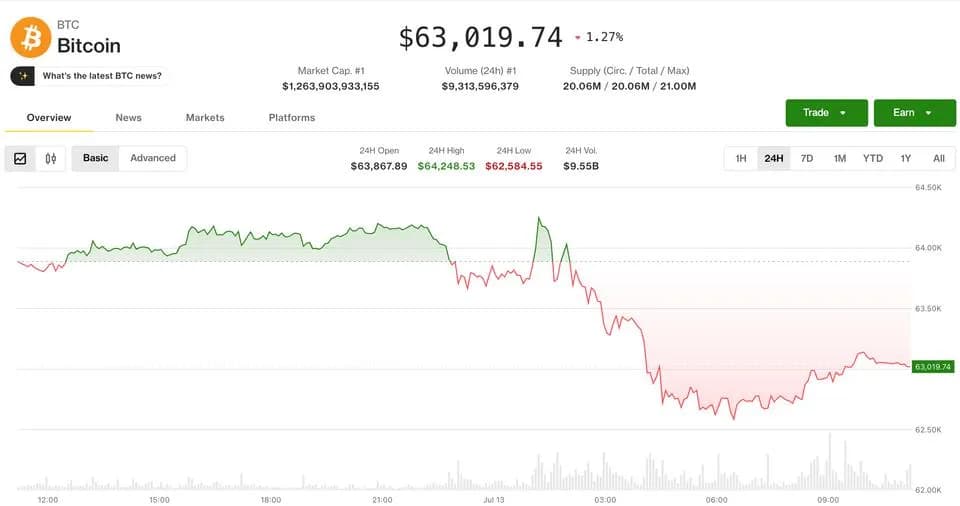
Bitcoin stabilized at $62,600 after Monday's drop, which saw the price fall from $64,400 to $61,800 in 24 hours. 24-hour liquidations reached $283 million, with a 74% to 26% split favoring long positions. Binance's heatmap indicates the key level to watch for further downside is $61,300.
This consolidation occurs in an environment where implied volatility remains relatively low. The DVOL, Deribit's volatility index, stands at 37.43, near its historical lows. Bitcoin options also show declining volatility, with the one-week delta skew compressed to 15% from 26% a week ago. The put/call ratio moved from 64/36 to 58/42.
South Korean investors are fleeing stocks for crypto, with a 1,426% increase in trading volumes on Upbit. This could mark a reversal of the digital asset exit trade that Korean investors executed at the end of last year. The KOSPI, South Korea's stock index, has lost 10% since Friday.
The KOSPI, which includes South Korea's major technology and industrial companies, has come under heavy pressure due to global market volatility and concerns about global monetary policy. The 10% drop has pushed many investors to seek alternatives less correlated to equity markets, such as cryptocurrency. Upbit, the most used crypto platform in Korea, saw its trading volume explode by 1,426%, reflecting a massive migration of capital into Bitcoin and other digital assets. This dynamic could reverse the trend seen at the end of last year, when Korean investors reduced their crypto positions.
This flight to crypto is part of a broader framework where investors seek to diversify their portfolios amid growing uncertainty in equity markets. The correlation between Bitcoin and stocks remains low, making it a safe haven for those looking to limit the impact of a potential stock market correction. Additionally, the strong growth in volumes on Upbit indicates that investors are looking to take advantage of the increased liquidity and short-term trading opportunities that cryptocurrencies offer.
The "machine chip trade," which saw Korean investors massively withdraw their digital assets at the end of last year, could be called into question by this new wave of investments. This trade was driven by fear of a revaluation of digital assets due to increased regulation and geopolitical tensions. However, the recent drop in the KOSPI has pushed investors to reconsider crypto as a viable alternative, showing that the perception of risks associated with digital assets is evolving rapidly.
Trading volumes on Upbit have also allowed investors to profit from the volatility difference between stock markets and cryptocurrencies. While stocks experienced a sharp decline, Bitcoin consolidated its gains, thus offering additional profit potential for those who chose to turn to digital assets.
In parallel, Bitcoin options show declining volatility, with the one-week delta skew compressed to 15% from 26% a week ago. The put/call ratio moved from 64/36 to 58/42. The DVOL, Deribit's implied volatility index, is at 37.43, near its historical lows.
Other digital assets
Ether (ETH) followed Bitcoin's movement, trading in a relatively narrow range of $1,770 to $1,790. Trading volumes on ETH pairs increased by 2.2% to $8.95 billion over the last 24 hours. Lighter (LIT) rebounded 5.7% since midnight UTC, after falling on Monday.
Ether's movement reflects the general trend of the cryptocurrency market, where top-tier assets tend to follow Bitcoin's dynamics. The narrow range of $1,770 to $1,790 indicates a strong presence of balanced buyers and sellers, which reduces the likelihood of extreme short-term movements. The $8.95 billion volume shows that traders remain active, which enhances market liquidity and stability.
Lighter (LIT), meanwhile, rebounded after a decline on Monday, illustrating the ability of some tokens to recover quickly due to strong fundamentals or effective marketing campaigns. The 5.7% rebound is significant, especially after a 200% increase since May, showing that investors remain attentive to opportunities for quick gains in the utility token sector.
US stock markets and gold
US stock markets were mixed, with Nasdaq 100 futures up 0.31% and S&P 500 futures down 0.12%. Gold continued its decline, losing about 28% from its all-time high in January.
The slight rise in Nasdaq 100 futures reflects investor confidence in technology companies, while the decline in S&P 500 futures indicates increased caution regarding sectors more exposed to high interest rates and geopolitical tensions. US President Donald Trump's statement, announcing that Iran would face "very heavy strikes" on Tuesday, added a layer of uncertainty, pushing investors toward assets considered safer.
The decline in gold, meanwhile, is the result of a combination of factors, including rising US interest rates and increased confidence in fiat currencies. Since its January all-time high, gold has lost 28%, showing that investors now prefer digital assets and technology stocks over physical gold.
Implications for investors
Investors should closely monitor the evolving situation, as markets remain volatile. It is important to maintain a diversified approach and not get carried away by emotions. Investors looking to profit from crypto growth must be willing to take risks and manage their exposure.
Crypto ETFs, such as MSCI World CW8 ETFs or S&P 500 PEA ETFs, can offer diversified exposure to equity markets and digital assets. However, it is essential to understand the risks and characteristics of these products before adding them to one's portfolio.
In conclusion, Bitcoin's consolidation at $62,600 and the increase in trading volumes on Upbit highlight a dynamic where investors seek to balance their portfolios between stocks and cryptocurrencies. The decline in implied volatility and the compression of the delta skew indicate that markets are in a state of low stress, which could allow crypto to stabilize further as investors assess current geopolitical and economic risks.