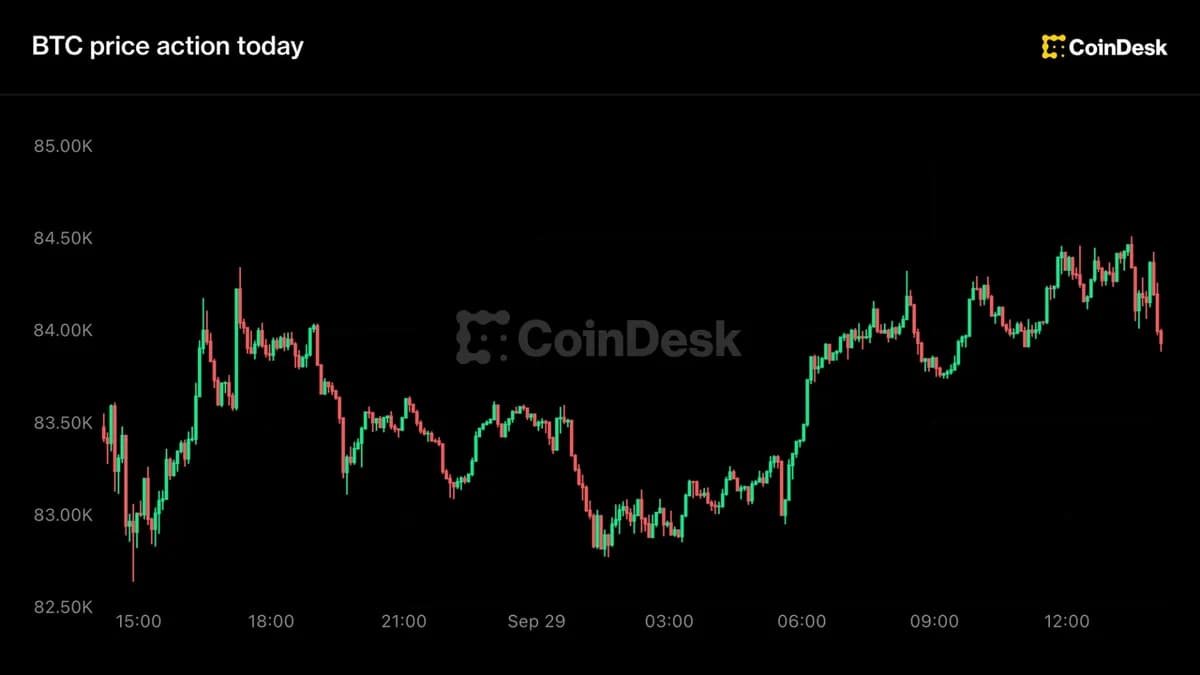
John Williams Signals 'No Urgency': Bitcoin Dips as Two-Year Yield Drops to 4.88%
New York Fed President John Williams stated that no urgency justifies another rate hike, causing the two-year Treasury yield to drop to 4.88%. Bitcoin and stocks continue to incur modest losses, reflecting a limited market reaction to monetary signals.
New York Fed President John Williams indicated on Tuesday that there was "no urgency" to raise rates again, noting that the Fed had already acted in September. This statement immediately caused the two-year Treasury yield to drop from 4.96% to 4.88%, leaving stocks and cryptocurrencies in a modest loss posture (CoinDesk).
Fed's Williams Signals Possible Rate Hike in October
John Williams elaborated that his baseline scenario envisions "only one additional rate hike this year," keeping the door open for a monetary policy decision in October. According to the same official, the probability of a hike in October has declined to 51% from 70% the previous day, reflecting a softening of market expectations. This shift in probabilities was highlighted by Bloomberg and the Wall Street Journal, emphasizing the weight of Williams' comments in shaping market rate expectations.
The climate of uncertainty surrounding future Fed decisions is gradually dissipating, but the margin for maneuver remains narrow. Fed analysts, cited by the Financial Times, note that inflation remains above the 2% target, justifying the central bank's prudence. In the absence of clearer macroeconomic data, the expectation of a single October hike remains the primary guideline for the committee.
Two-Year Treasury Yields Decline to 4.88%
The movement in the two-year Treasury yield, dropping from 4.96% to 4.88%, represents the most tangible market reaction to Williams' remarks. This 8-basis-point decline indicates that investors perceive less urgency in monetary policy, easing pressures on short-term fixed-income markets. Data published by the Federal Reserve in the same communiqué confirms that money market fund purchases of Treasuries have slightly increased, supporting the downward dynamic of yields.
This development has also impacted funding costs for businesses, particularly those listed in the U.S., where the two-year interest rate serves as a reference. A yield decline reduces borrowing costs, which could encourage corporate investment plans, despite lingering uncertainties tied to monetary policy. Bloomberg reports that credit spreads have narrowed by 15 basis points, reflecting a renewed confidence among institutional investors.
Bitcoin Continues Modest Loss Despite Rate Relief
On the crypto front, Bitcoin continued to slip, showing a modest loss for the day, alongside major equity indices. The lack of a significant market reaction to yield declines suggests a temporary decoupling between traditional markets and digital assets. CoinDesk notes that Bitcoin volatility remains contained, with movements under 1% over the last 24 hours.
This inertia may stem from the perception that softer rate expectations are insufficient to spur mass crypto demand, which remains seen as a high-risk asset. Flows into Bitcoin exchange-traded funds have not shown notable increases, according to SEC tracking data. Thus, even with reduced yield pressure, the Bitcoin market remains cautious, awaiting a clearer Fed signal.
Analysis of the Link Between Rate Expectations and Cryptocurrencies
Fed economists emphasize that rate hike expectations directly influence capital opportunity costs. When Treasury yields rise, investors tend to favor fixed-income assets, sidelining cryptocurrencies. Conversely, a yield decline, as seen with the two-year rate dropping to 4.88%, reduces this opportunity cost and could support Bitcoin prices, provided the signal is perceived as durable.
In this case, the reduction in October hike probabilities (from 70% to 51%) has indeed eased downward pressure, but Bitcoin's lack of reaction indicates that market players are waiting for stronger confirmation. The Financial Times explains that institutional actors, who now hold a significant portion of Bitcoin trading volume, are closely monitoring monetary policy indicators before reallocating their portfolios toward crypto assets.
Short-Term Scenarios for Bitcoin Price
If the Fed confirms another rate hike in October, Treasury yields could rise again, pushing investors back toward fixed-income assets. In this scenario, Bitcoin could face additional pressure, driving its price toward lower support levels. CoinDesk analysts estimate that, in such a configuration, Bitcoin could test important psychological thresholds, though exact figures are not specified in the brief.
Conversely, if Williams' comments lead to rate stability for the remainder of the year, Bitcoin could benefit from a moderate upward dynamic, supported by the search for alternative assets offering better returns than low-yield Treasuries. Market crypto experts note that, in such an environment, inflows into Bitcoin exchange-traded funds could accelerate, enhancing liquidity and stabilizing prices. The most likely scenario will depend on how rate expectations evolve over the coming weeks.