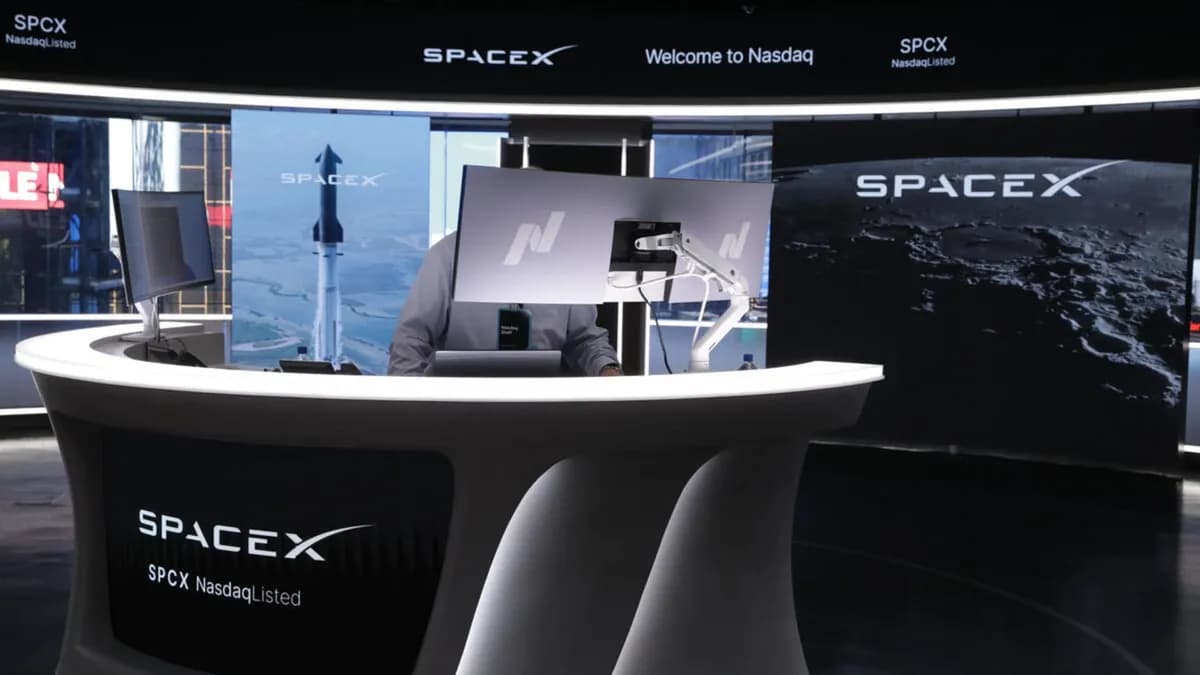
SpaceX down 38% from its peak, Evercore ISI still sees 65% upside
Despite a 38% drop from its post-IPO high, Evercore ISI initiates coverage of SpaceX with an 'outperform' rating and a $230 target, implying 65% upside. The analyst calls the profile 'too compelling to ignore'.
SpaceX: Evercore ISI sees 65% upside despite recent decline
SpaceX has lost nearly 7% over the past five days and is down more than 38% from its all-time high of $225.64, amid doubts about its valuation and ambitions. Yet Evercore ISI initiates coverage with an 'outperform' rating and a price target of $230, implying 65% upside from Monday's close. This contrast between the recent weakness in the stock and the optimism of a top analyst raises questions about the long-term dynamics of the stock and the credibility of expected catalysts.
A $230 target betting on Starship and Starlink
Analyst Kutgun Maral justifies this target by the company's project pipeline. He stated that the bullish bias is too compelling to ignore, in a note published Tuesday. He specifically cites the deployment of the heavy-lift Starship by the end of the year, the ramp-up of Starlink, and the development of Grok in AI as catalysts. He added that growth can accelerate rather than fade over the course of the decade. To understand the 65% upside potential, each of these projects must be examined. Starship, the fully reusable heavy-lift launch vehicle, is designed to transport payloads and crews to the Moon, Mars, and beyond. Its commercial deployment by the end of 2026 would open new revenue streams, including government contracts (NASA, Department of Defense) and private missions. Starlink, the low Earth orbit satellite network, already has millions of subscribers and generates recurring revenue; its expansion into rural areas and emerging markets could accelerate growth. Grok, the AI model developed by xAI (linked to SpaceX), aims to compete with large language models like GPT-4; if SpaceX integrates Grok into its operations or commercializes it, that would add a new growth leg. Maral believes these projects, while ambitious, are achievable and that the market underestimates their cumulative impact on revenue and earnings over a 3-5 year horizon.
Of the 31 analysts covering SpaceX, 26 recommend buy or strong buy, according to LSEG data. The recent drop has therefore not dented sell-side confidence, which sees the correction as an entry opportunity. The analyst insisted that one can debate the feasibility of certain ambitions and timelines, but there is no debate that this is an extraordinary company on a true path to reshape the future of humanity. This relative unanimity is rare for a recently listed technology company. Typically, disruptive IPOs spark a polarized debate between bulls and bears. Here, the buy consensus reflects the conviction that SpaceX has a sustainable competitive advantage in space (reusable launchers, Starlink constellation) and that its ambitions in AI (via Grok) could create a unique synergy. However, the fact that the stock has fallen 38% from its peak indicates that investors are more skeptical than analysts. This gap between market price and analyst opinion can signal either an opportunity (if the market is wrong) or a risk of further decline (if analysts are too optimistic).
Challenges ahead: valuation and timing
Investors remain cautious, however: the stock has lost more than a third of its value since its record IPO. Questions linger about SpaceX's ability to deliver Starship on time and to make Starlink profitable amid competition. The $230 target assumes the company overcomes these obstacles. For now, the market seems to demand tangible proof before rewarding the stock. The main challenge is timing: Starship has faced delays and test failures; any further delay beyond 2026 could erode confidence. Starlink, though a leader, faces competition from rival projects (Amazon's Kuiper, OneWeb) and regulatory issues in some countries. Grok, meanwhile, is still in development; the AI market is saturated and dominated by established players. Finally, valuation remains high: even after the drop, the forward price-to-earnings ratio is above that of most tech stocks. Evercore ISI is betting that future growth justifies this premium, but any operational misstep could trigger another correction. Maral's note comes at a pivotal moment: if SpaceX can demonstrate tangible progress on Starship and Starlink in the coming months, the stock could rebound strongly. If not, the consensus could crack and the $230 target would be called into question.